
“Battle of Rhode Island” Film Images: Historical Corrections
Share this Page
Viewers who watched the film closely identified some historical inaccuracies in our AI-generated illustrations. Their observations provide an opportunity to explain how the images were made, where they fell short, and what the correct details should be.
The illustrations were created to help viewers imagine the people, places, and events surrounding the Battle of Rhode Island in August 1778. They were intended as interpretive visualizations grounded in historical research, not as exact visual reconstructions or substitutes for documented contemporary images.
No known contemporary visual record provides a complete, eyewitness-style depiction of the battle as it unfolded as this was before photography and videos. To visualize scenes for which the surviving record is fragmentary, the production drew on maps, military plans, paintings, sketches, letters, diaries, and other historical sources.
How the images were created
Each AI-generated image began with a detailed written prompt, much like a briefing for an illustrator. The prompt specified the historical moment, location, people, action, terrain, buildings, ships, weather, time of day, and visual style.
Period sources guided details such as troop positions, uniforms, flags, shorelines, fortifications, and architecture. Initial images were then revised to improve specific elements and compared with the available evidence before final selections were made for the film.
Although image generation can be rapid, historically specific scenes require substantial research, revision, and review. Even careful research and repeated revisions cannot guarantee accuracy. The two examples below show details that escaped review and should have been corrected before release.
Correction 1 - British flag
Film image at 0:25


The flags shown on the hill and ship mistakenly depict the British union flag adopted in 1801. In 1778, the British union flag did not yet include the red diagonal cross of St. Patrick’s Cross.
The difference is subtle but historically important:
Correct 1778 Flag
The version appropriate to 1778 combined St. George’s red cross with St. Andrew’s white saltire on a blue field. It did not include a red diagonal cross.

Incorrect Later Version Used
The flag adopted in 1801 added St. Patrick’s red diagonal cross, creating the later version mistakenly shown in the film.
This difference may appear subtle at a glance, but it is historically significant.
Union Jack adopted in 1801
The flag adopted in 1801 added St. Patrick’s red diagonal cross, creating the version mistakenly shown in the film.

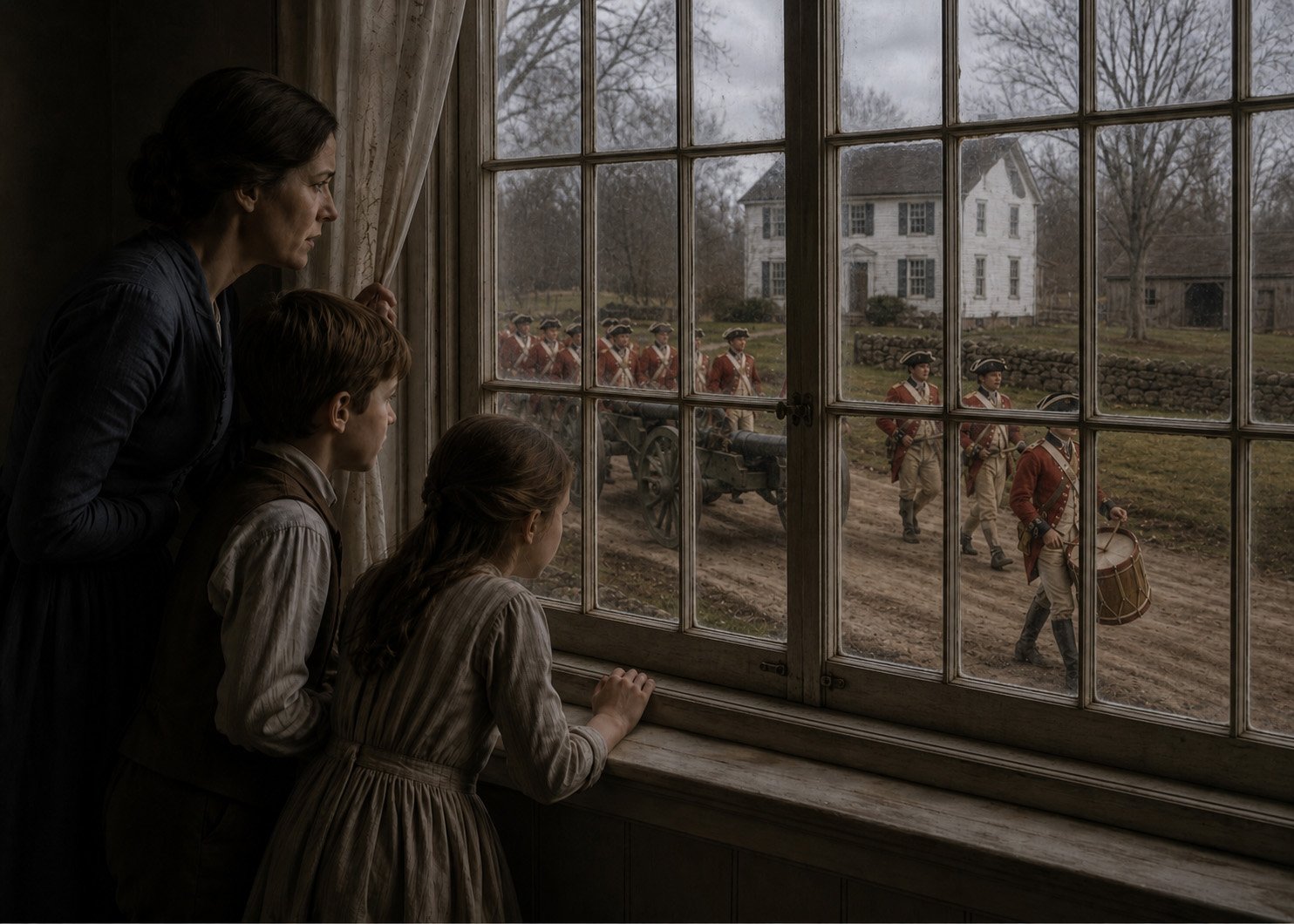
Correction 2 - Interior window
Another viewer also noticed problems with the window in a scene intended to represent a New England interior of the 1770s. The overall form—a tall, narrow, multipaned double-hung sash—is plausible. Several details, however, are too modern and generalized to serve as a reliable depiction of a documented late-eighteenth-century interior.
Film image at 8:31

Window Details
Glass. The panes appear too clear, large, and uniform. Handmade crown or cylinder glass commonly showed waviness, bubbles, streaks, and uneven reflections, and individual panes were generally smaller.
Sash. The image lacks muntins between individual panes and a legible meeting rail where the upper and lower sashes meet. Common late-eighteenth-century arrangements included 12-over-12 and 9-over-9 sashes.
Hardware. Depending on the angle and condition of the window, period-appropriate hardware such as a sash fastener and lifts might also be visible.
Interior Trim and Joinery
Trim. The casing, interior stool, apron, and molding lack the definition expected in a well-documented late-eighteenth-century interior.
Sill. The broad, smooth ledge and generalized framing do not convey period joinery.
Revised illustration
Two further viewer comments


Another comment
One viewer offered a joke; we leave it for readers to enjoy.

Viewer Engagement
Thoughtful corrections and historical discussion are welcome. The Battle of Rhode Island deserves careful study, and the film has prompted viewers to look closely, ask questions, and share their expertise.
Thanks are due to everyone who engaged with the project, especially those whose close attention helped identify errors and improve the historical record presented alongside the film.
Joe Studlick and Michelle Girasole
