
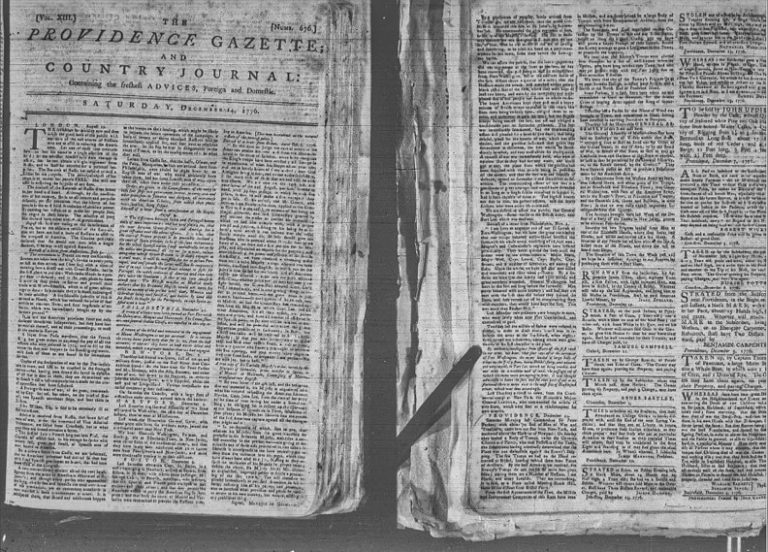
1776: Gleanings From the Year as Reported in the Pages of the Providence Gazette
A year of Revolutionary War history as it was actually read by Rhode Islanders at the time — week by week.
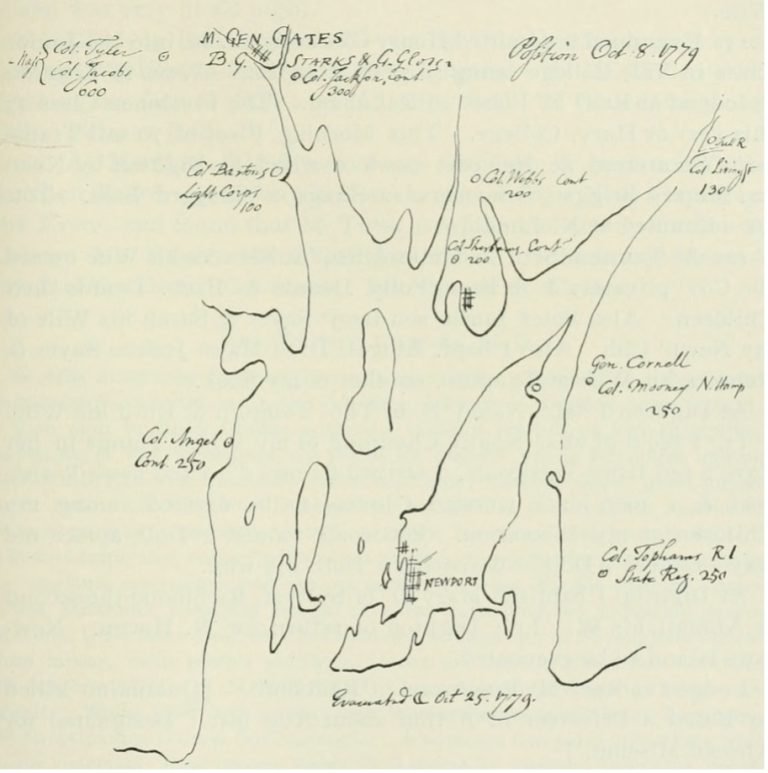
Little Compton and the Battle of Rhode Island
Steven Lubar explores how the town’s residents endured raids, scarcity, military service, and constant uncertainty during the British occupation of nearby Aquidneck Island.

Bristol in the American Revolutionary War
Discover Bristol, Rhode Island’s vital role in the American Revolution, including the 1778 British raid and the roots of the nation’s oldest Fourth of July celebration.

Butts Hill Fort Leads Off Portsmouth 250th Celebrations
Butts Hill Fort came to life on the first weekend in May 2025 as we collaborated with the Brigade of the American Revolution (BAR) to bring together reenactment regiments from six states to form an authentic living history encampment.

Historic Lafayette House in Tiverton Demolished
In a shocking turn of events, the historic Abraham Brown House, also known as the Lafayette House, was demolished on December 18, 2024, in Tiverton, RI.

British Casualties in the Battle of Rhode Island
Amid the chaos of battle, soldiers faced wounds, loss, and survival, shaping their fates for years to come.

Digging in: Information from Robert Selig’s work on the French at Butts Hill
BoRIA sponsored valuable research on the construction of Butts Hill Fort by Robert Selig and John K. Robertson.
Preparing for a Visit of Rochambeau to Butt’s Hill
In a letter dated August 2, 1780, from Newport, Lafayette wrote to American General William Heath about how to prepare for Rochambeau’s visit.

The Settlement of Prudence Island And its Abandonment During the Revolutionary War
This paper is an account of the settlement of Prudence Island in Narragansett Bay, RI, prior to, and including its abandonment during the War for Independence.

Rochambeau’s Engineers at Butts Hill Fort July 1780 – June 1781
Butts Hill Fort was built early in the American War of Independence to protect the northern approaches to Newport, Rhode Island. Within days of his arrival in July 1780, the comte de Rochambeau sent his engineers to supervise and assist American forces in rebuilding and strengthening the fort.

Highlights of the Timeline of the 1st Rhode Island Regiment
Highlights from a timeline covering the formation and service of the racially diverse 1st Rhode Island Regiment during the American Revolution by historian Robert Geake.

Siege of Newport
Historians differ on when to mark the beginning of the Siege, but I am using August 9th, 1778, as the start of the Siege. This is the date the Americans transported their soldiers by ferry from Tiverton to Aquidneck Island and set up camp in Portsmouth. We tend to focus on the battle, but the siege portion of the Rhode Island Campaign includes the dates of August 9th to August 28th when the American leaders decide to execute a planned retreat. This retreat marked the end of the Campaign.

Seth Anthony Remembers the Battle of Rhode Island
In researching Revolutionary Rhode Island, I came across a book by Judge Benjamin Cowell. Cowell was born in 1781, so he wasn’t a Revolutionary War veteran, but he made it his aim in life to help Rhode Island veterans get their pensions. He began recording the stories these old soldiers had to tell to justify their service. Cowell began to gather eyewitness accounts, speeches, letters, rosters, and every piece of information he could find on Rhode Island’s role in the War for Independence. In 1850 he gathered all this material into a book “Spirit of ’76 in Rhode Island.”

The Call to Arms in Rhode Island and the Community of Artisans who Crafted Them
The coming of the Revolutionary War brought a host of challenges to the upstart colonies, chief among them was a lack of weapons and ammunition that would be used to defend communities against attack as well as weaponize the militias and Continental Army that were sent to fight the War of Independence.

Privilege & Preservation: The Reverend Doctor Roderick Terry, “An Apostolic son of a millionaire” & the Historical Landscape of Rhode Island
An original article written and researched by Michael J. Simpson which tells the story of Reverend Dr. Roderick Terry and his vision for Butts Hill Fort and the legacy of the Battle of Rhode Island.

Life on Aquidneck Island during the British Occupation, 1776-1779
Aquidneck Island today is a truly beautiful island with remarkable natural beauty: the ocean, the beaches, sea breezes, meadows and marshlands, the ubiquitous fieldstone walls, and the many open spaces and farmlands in Portsmouth and Middletown.

The Battle of Rhode Island: An Impressive Performance by the American Army
The largest battle of the Revolutionary War in New England was well-fought by the Continentals.

“Roderick the Magnificent” – Saving Butts Hill Fort and Fort Barton
Roderick Terry was a preservationist responsible for saving Butts Hill Fort and Fort Barton.

Resources on The Battle of Rhode Island and Revolutionary Rhode Island
This is an annotated list of sources on the Battle of Rhode Island.

The Battle of Rhode Island
This overview of the Battle of Rhode Island argues that the battle is important to us because it was fought here.

British Soldiers in Rhode Island, December 1776 – October 1779
One day in September 1778 John Hopwood was hard at work. The thirty-five-year-old native of Hutton, a village in the eastern part of Yorkshire a few miles from the coast, was a butcher, but at the age of twenty-eight had chosen a different career – he enlisted in the British army, in the 54th Regiment of Foot.

Patriots at Rest in Newport!
Some people die participating in the war and others are fortunate to return to their prewar lives. At some point they all die.

The Potter/Dean – Narragansett Tavern House Wickford (North Kingston), Rhode Island
The village’s most prominent house wright, Robert Potter purchased this parcel of land from his frequent business associate Samuel Bissell.

Captain Thomas Cole
This early colonial was constructed for Samuel Phillips in 1773 on land he purchased from his relation Richard Phillips the year before.

The Newtown (Wickford) Rangers
The Newtown Rangers were made up of boys too young and men too old to serve in the armies of the Revolution.

Two Fine Wickford Homes with Their Roots Firmly Planted in The Revolution
This early colonial was constructed for Samuel Phillips in 1773 on land he purchased from his relation Richard Phillips the year before.

Rochambeau in Rhode Island July 1780- June 1781
The eleven months which the little army of Jean Baptiste Donatien de Vimeur, comte de Rochambeau, spent in Rhode Island progressed through a process of “getting to know each other”

A Fight for Freedom and Dignity: The Recruitment, Service , and Legacy of the 1st Rhode Island Regiment
The attempted formation of a regiment of soldiers composed entirely of enslaved men who had enlisted to earn them their freedom.
