
1776: Gleanings From the Year as Reported in the Pages of the Providence Gazette
Transcribed with Notes by Robert A. Geake
Share this Page
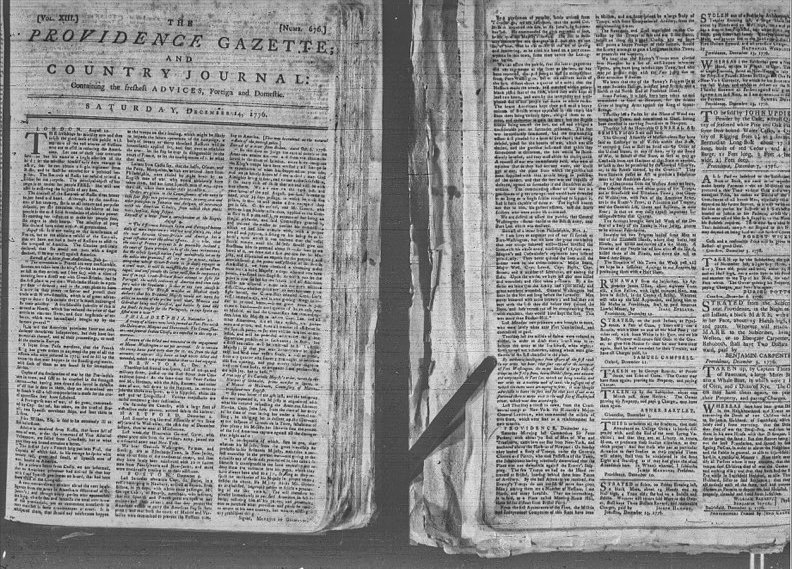
1776: Gleanings From the Year as Reported in the Pages of the Providence Gazette, gathers a year of Revolutionary War history as it was actually read by Rhode Islanders at the time — week by week, in the pages of John Carter’s patriot newspaper, printed at the Shakespeare’s Head press in Providence. From January’s raids on Goat Island and Conanicut through the privateering campaigns of late fall, the Gazette‘s reports capture the immediacy and uncertainty of a war still being fought close to home: British tenders harassing coastal shipping, militia companies rushing to Warwick and Prudence Island at the first alarm, and news of distant battles like Moore’s Creek Bridge arriving weeks after the fact, filtered through correspondents, packet boats, and reprinted dispatches from other colonial papers.
I preserved the original spelling and phrasing of each notice, adding bracketed clarifications only where needed, and let an extensive set of endnotes carry the historical weight — identifying the ships, officers, privateers, and local figures who appear, often only by surname, in the original reporting. Privateers were often owned by merchants, who hired several captains to command vessels on up to three or four “campaigns” during the course of the year. Other vessels were owned by the Captain themselves, and usually put out to sea for an equal number of voyages. Names of both people and places were sometimes misspelled in the newspaper reports, and I have corrected those in the footnotes. The result reads less like a conventional narrative history and more like the raw material of one: a year of Rhode Island’s war assembled from the same fragmentary, delayed, and sometimes contradictory reports that shaped how its residents actually understood what was happening to them in 1776.
Taken together, the entries trace a state under direct, sustained pressure from Royal Navy forces stationed at Newport — coastal raids, seized cargo, burned buildings, captured passengers — alongside the first stirrings of Rhode Island’s own privateering fleet and its Continental Navy connections through Providence-built and Providence-crewed vessels. It’s a granular, ground-level companion to the more familiar sweep of 1776’s national history.
January 6th
“Monday night last [Jan. 1] a party from Head Quarters on Rhode Island set fire to the houses and barracks on Goat Island[1]. A number of men from the King’s Ships landed and saved one of the buildings[,] the others with a quantity of furniture &c. were destroyed.”[2]
“Tuesday last a Sloop with passengers principally women in coming up the River from Newport was stopped by a Barge from one of the Kings Ships although a pass had previously been obtained from Capt. Wallace[3]. The vessel was detained for two days[,] robbed of what provisions was on board and two passengers were ordered on board one of the ships where they remain.”
“The same day the Bomb Brig[4] and one or two Tenders[5] went to Conanicut[6] from whence they were fired on by a party of men stationed there. They returned fire with their cannon but without effect and were finally obliged to move off.”
January 7th
“A midshipman and two women were captured by a small party of Minute Men from Head Quarters on the Island. They procured a negro man to hail the British Tenders from the shore at Brenton’s Point[7] and inform them that two men were there wishing to enter into his Majesty’s service when the boat was sent on shore with an officer and two men which were immediately captured and carried to Head Quarters.”
January 13th
“Yesterday [Jan. 12] afternoon Capt. Wallace with all the vessels under his Command arrived at the South End of Prudence and landed 250 men. The minute Men that were on the island (about 47 in number) marched and engaged the enemy who endeavored to surround them.
One Minute man was killed and two wounded and the enemy it is said lost several of their men. They afterwards burnt eight houses on the island with a number of barns and cribs and this morning it is said they arrived in Bristol Harbour.”[8]”
“On Monday last…a Ship (supposed to be the Swan)[9] and four Tenders left the Harbour of Newport and came up the Bay. They fired a number of shot at a house on the Narragansett side after which the Brig and Tenders came up as far as Warwick Neck[10] where it is supposed they intended to land some men for the purpose of collecting livestock &c. Advice being received here of the Movement about Eleven o’clock at night[,] the Artillery Company marched off with some field pieces and arrived at Warwick early the next morning where they were joined by a number of the inhabitants and a company from East Greenwich with two field pieces. Several shots were fired at the Brig and Tenders and a few were returned on the part of the enemy who finding they could not accomplish their purpose returned to Newport on Wednesday having in this Expedition left two of their boats which were driven ashore near Warren[11]. In coming up the Bay they took a small sloop with some passengers on board.
We are desired to mention that when any Alarm being given in the town of Providence[,] the inhabitants (particularly those belonging to the several Companies) are to appear with their Arms and repair to such Alarm Posts as may hereafter be appointed.”[12]
January 21st
“…we beg leave to represent to your Majesty, that the redress of every grievance, the security of our violated rights, the relief from all our sufferings, the prayer of every petition, the [resuscitation] of unanimity, harmony, and peace (so often recognized by your Majesty – from the throne) are all in your Majesty’s power to bestow; for the injuries we have sustained, and the evils of which we complain, have been voted and produced by your Majesty’s own ministers, officers, and servants, by the members of Parliament, especially who are under the immediate influence of the crown.
Your Majesty has long been happily situated as to have a choice of means to give redress and contentment to your people; either by removing such of your servants who have done the wrong…dismissing those who have refused their concurrence, or by dissolving the present Parliament: That so, since no adequate provision has hitherto been made to prevent the crown and its ministers from choosing all their servants and dependents from among the Representatives of the people, the people, by a fresh election, may have an opportunity of choosing for their Representatives those who shall not be the servants and dependents of the crown and its ministers.
By the choice of independent, unbiased, and real Representatives of the people, and by the measures which such men will naturally take to protect our security, we trust, under the good Providence of God, that we shall not continue to see in this kingdom, electors denied the right of election, juries denied the right of judgement, and petitioners denied the right of complaint.”[13]

Boston, January 21st
“The opinion among the trading people in England, in general, is that a war will take place; but till it is more certain, they decline making proper insurance, and yet fear to ship their goods for exportation, at a hazard, which occasions a stagnation in trade.”
Providence, January 26th
“A Schooner is arrived at Marblehead from the Straits[14], but last from an out-port in England where she performed a quarantine of 40 days, conformable to the prudent measures adopted by Government for preventing the Introduction of the Plague, which still rages in some Ports up the Straits; great care aught therefore to be taken, that every Vessel coming from thence to any of the Colonies, deserves a strict Quarantine, that the Introduction of a great Calamity may, under Divine Providence, be effectually prevented…”
Boston, January 28th
“Friday last Captain Hill[15] arrived at Marblehead from Lisbon, which he left the 21st of December; a gentleman there, in a letter of the 19th , writes “that Mr. Potter (the messenger from the English Court) left Madrid the 7th of November and that they impatiently waited an answer from Britain to their overtures, which was expected by the 4th of December. – There was no account of a War when the above vessel left Lisbon.”
Providence, February 2nd
“A vessel arrived at Marblehead from England after a short Passage. A paper brought by her contains the Earl of Chatham[16]’s speech in Parliament, which we are told is very Spirited, and highly reflects on the Conduct of the Ministry.”
Saturday, February 16th (From the London Chronicle, excerpts from a letter signed by “A Whig and an Englishman” )
“…a King of England who engages in a foreign war without being supported by a hearty concurrence and confidence of his people, not only runs all the hazards incident to war, but is exposed to the unhappy necessity of answering to his subjects for events, for which otherwise they would never think him accountable. If the ground be not firm under him, every effort he makes to annoy the enemy, will shake his own establishment. If the people be not parties with him, they will be severe judges of his Conduct…
I have not heard it asserted that the people of Ireland, America, or England, however affectionate they may be thought to his Majesty’s sacred person and family, have any respect for his servants, or any confidence in his government. The Ministry themselves confess the contrary. When they look forward to a War as a means of restoring harmony at home, they tell us that, in effect, we are a disunited, discontented people. To what degree they think us so may be collected from the desperate remedy they offer us…
The unaccountable, contradictory measures pursued by government, have not only deprived us of the affection and alliance of the Americans (which in war they have been in all times ready to contribute), but oblige us to keep, in a state something worse than inactive, a force, which might be employed against the enemy. If the strict right of taxation were ever to clear, if the legal argument were ever so conclusive, a war cannot be maintained while three millions of our subjects stand neutral, or are ready to part against us. Necessity will compel us to revert at last to Lord Chatham’s doctrine[17], and leave the Americans to tax themselves…”
Providence, February 16th
“Several Vessels are arrived at Newport from the West Indies, and bring Advice that the Spaniards and French continue to make great Preparations for War – It was reported in Statia[18] that 160 Sail of vessels were fitted for privateers at Martinico and Guadaloupe, and Ready to proceed on a Cruize on an Hour’s Notice, whenever a Declaration of War should take place. We further learn that an English Schooner had arrived at Statia, the Master of which informed, that near that place he was brought to and robbed by a Spanish armed vessel; that the Spaniards stripped and bound his Crew, telling them that War was declared, and after whipping them severely, suffered the vessel to proceed on her voyage.”
Crops were like to be good in most of the Islands. The Captains Joseph and John Crawford[19] of this Port, touched at Statia about the Middle of January, and sailed to Leeward. Captain Abraham Smith, and Captain Joseph Cooke, of this Place, were at the Grenades…
In a Storm last Saturday, a Schooner from Virginia, Zephaniah Brown, Master, lying near Fox Point, parted her Cable and ran ashore. One of the Packet-Boats was likewise drove ashore at the same Place. A Stable was blown away in Town, and Part of the Bannister of the Great Bridge carried away. At Warren and Barrington some old buildings were unroofed…”[20]
February 24th
“Saturday evening [Feb. 17th] last the Ministerial fleet went down the Bay to Newport and have since returned to Hope Island.[21]
The same day a Brig put off from Newport for New London having on board a quantity of salt[,] some household furniture & c. The hands being apprehensive that they should be taken and impressed[22] by the Ministerial Fleet [,] obliged the Captain to put back but in returning[,] the vessel ran aground near the entrance of the Harbour where as she could not be defended[,] some Men from Head Quarters went on board and assisted in unbending their sails and saving some of the furniture. Wallace discovered her next morning when the Bomb Brig and a Tender took possession of her. A few shot(s) were exchanged between them and some of our people on shore but without doing any damage. After taking out the salt they set her on fire and she burnt to the water’s edge.”[23]
March 9th
“Tuesday night last [March 6th] in a severe gale of wind two Sloops and a Schooner belonging to the Ministerial Fleet were drove ashore on Hope Island[,] one of the Sloops is entirely under water and the Schooner dismasted.”
March 16th
“On Friday of last week [March 8th] the ship Swan…in going down the River ran on the Blue Rocks[24] near Newport where she lay 5 hours but got off without receiving much damage.”
March 30th
“The Ministerial Fleet on this Station which sailed from the Harbour of Newport on a Cruise Wednesday and Thursday…returned the day following with two prize Sloops both from New Haven with provisions one of them bound to the West Indies the other to the Eastward. They have since it is said taken three other prizes.” [25]
New York, April 8th
“Last Tuesday night a party of about 150 of our troops landed at Bedlow’s Island[26], about two miles from this city and destroyed some works that had been crafted there by the crew of his Majesty’s ship the Asia, and burnt down a boat supposed to be possessed by some Tories. The Man of War fired two shots at our people, but they came off unhurt, and brought with them some intrenching tools, poultry, &c, &c.
The same evening an attempt was made to set fire to the air-furnace near this city, by some people that got there in a boat, and supposed from the Man of War; but they were discovered before they could put their design in execution…”
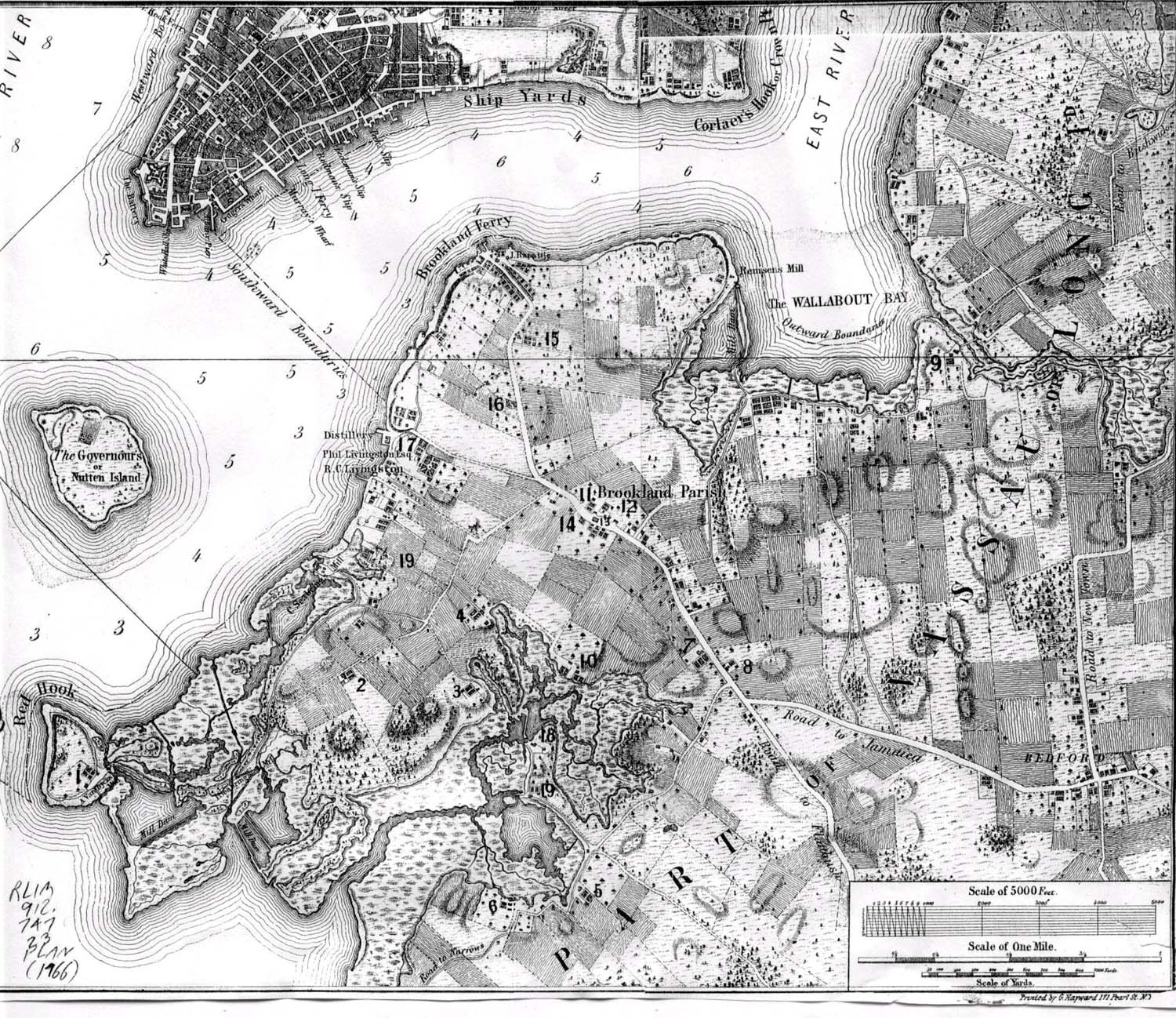
Notice: Providence, April 12, 1776
“Those persons who received Town Arms in the late Alarm[27], are desired to return them immediately to the Parsons who delivered them.”
North Carolina, April 13th
(news of a skirmish at Moore’s Creek in February)
“I have the pleasure to acquaint you that we had an engagement with the Tories at Widow Moore’s Creek bridge[28] on the 27th…Our army was about 1000 strong, consisting of the Newborn battalion…the militia of Craven, Johnston, Dobbs, Wake, and a detachment of the Wilmington battalion of minute-men which we found encamped at Moore’s Creek the night before the battle…
The Tories by common report were 3000 but Gen. McDonald[29] whom we have as prisoner says there were about 15 or 1600 that day, he was unwell that day, and not in the battle- Capt. McCloud who seemed to be the principle commander, with Capt. John Campbell are among the slain. The number killed and mortally wounded, from the best accounts I was able to collect, was about 30; most of them were shot on their passing the bridge. Several had fallen into the water, some of them I am pretty certain, had not risen yesterday evening when I left the camp: such prisoners as we have say, there were about 50 of their men missing. The Tories were totally put to the route, and will certainly disperse…” (Brig. General J. Moore)[30]
Newport, April 14th
“Last Tuesday as two freight boats were coming from Updike’s Newtown[31] of this colony…with wood, cider, butter, eggs, and towcloth, the ship of war stopped them, and took out 17 barrels of cider, all the butter and eggs, and some potatoes, which it is said they paid for, and detained two passengers (who were bringing some of these articles to market) several hours on board the ship. The Tories here…say the ships did not break the truce with this town as the passengers are from Connecticut.
Last Wednesday night 3 Negroes, from this town, went on board the man of war lying in our road[32]. It is supposed that all Negroes fled on board their ships will be sold in the West Indies in a very short time.[33]
Philadelphia, April 23rd
“ A few days past a ten gun sloop commanded by Capt. Wright….and a sloop of six guns commanded by that infamous old puritanical scoundrel John Goodrich[34], one of the parties of Lord Dunmore’s sad company, came over Orokak [35]bar, [of] this province, and took 4 vessels outward bound…The ten gun sloop immediately went out to sea with two of the prizes. The wind not being fair, Capt. Goodrich’s sloop and the two prizes remained within the bar. Twenty three men, headed by a brave young man (Benjamin Beanor of Pamlico river) in four whaleboats, boarded the old pirate sloop of six guns, sword in hand, and profited themselves of her and the whole crew, a tolerable cargo of valuable articles. They also took the two prizes, several of Goodrich’s negroes, a Capt. George Blair of the Queen’s own royal regiment of Blacks[36], and a soldier of the 14th Regiment among the prisoners…”
May 3rd (News from Williamsburg)
“Last Sunday fortnight a tender came up Rappahannock and chased a New England schooner outward bound, late Hobbs Hole[37], from whence she carried her off, as low down the river as Bowler’s warehouse, where she got aground on an outer bank, and stuck there until the Tuesday following; by which time some spirited gentlemen in the neighborhood got together four sailing boats and massed them with a plan to retake the prize, and , if possible, to board the tender, which was commanded by one of old Goodrich’s sons, and had on board a large quantity of sail canvases, &c. As soon as the tender’s people saw our vessels bearing down on them, they set fire to the prize and quitted her; upon which some boats from [shore] put off, and arrived time enough to extinguish the fire without its materially damaging the vessel…
Mr. Hugh Walker[38] and Mr. Richard Banks, who commanded two of the vessels, got quickly up with the tender, and engaged her at close quarters for at least 15 or 20 minutes, with small arms, during which, a valuable negro man, a pilot onboard Mr. Walker’s vessel, was shot through the head, attempting to board, and three or four of the tender’s people were seen to fall, when a breeze springing up, Mr. Goodrich took advantage of it, and ran off leaving his prize behind which is now safely secured.”
May 20th, Norwich
We hear that a Dutch sloop from Corseca (Corsica), (?) 12 carriage guns, 18 swivels, and 80 men on board bound to New York with 13 tons of powder, such values in salt petre, and a quantity of dry goods for the ale of the Americans, was met with in the Sound last week.
May 25th
“Friday….Capt. Mugford[39] in a small privateer from Marblehead took and carried into Boston a Ship from Ireland with a very valuable Cargo of Powder & c. destined for the Supply of the miserable Army and Fleet which lately fled Boston. The following is sent as a List of her Cargo: 3501 barrels of Powder (weighing as an Average 108 lbs each) and 3 half barrels…accounting in the Whole, to upwards of 75 Tons, all Copper hoop’d. 49 chests containing 1000 carbine with Bayonets compleat, 18 chests of Carpenters tools, a large quantity of Intrenching tools, 10,000 sand bags, 300 leather shields.”
May 25th
“To be sold, a likely young Negro girl, that can do all kinds of House Work, and is an excellent Washer &c. Enquire at the Printing Office.”[40]
June
“In General assembly, June session 1776, Resolved, That Mr. Henry Peckham for the county of Newport, Pardon Tillinghast for Kings County, Thomas Greene for the County of Providence, Thomas Tillinghast for the County of Kent, and Benjamin Bosworth in the County of Bristol be a Committee, they, or the major Part of them, to make swift inquiry what Damages have been done within the Colony by soldiers before the act was made against such damages being paid by the Colony, and directing who should pay the same…and make Report to next session of Assembly.”
July 19th
“Made public by order of Congress, Williamsburg, Virginia. The following is a particular account of the Attack and rout of Lord Dunmore, with his piratical Crew from Gwyne’s Island.[41]
We got on the island on Monday the eighth, and next morning, at eight o’clock, began a furious attack upon the enemy’s shipping, camp, and fortifications, from two batteries, one of five, six, and nine pounders, the other mounting two eighteen pounders. What forces the enemy had were encamped at a point on the Island nearly opposite to our five gun battery, a battery four embrasures and a breastwork of considerable extent. Besides this, they had two other batteries, and a stockade fort, higher up the haves, where troops were stationed to prevent our landing…
General Lewis[42] announced his orders for attacking the enemy by putting a match to the first gun, an eighteen pounder, himself, and the Dunmore being nearest to us, at the distance of only four or five hundred yards, the (shot) passed through her hull, and did considerable damage. Our five gun battery likewise began playing on the fleet, the enemy’s camp and works: and the fire soon became so hot that the Dunmore was obliged to cut her cable and haul off. Our eighteen pounders did great execution from the upper battery, which raked the whole fleet, and Capt. Deeny who commanded the other battery soon silenced the enemy at the polar, knocking down several tents which put their camp into great confusion…
Gen. Lewis then ordered two hundred men to land on the island…On our arrival, we found that the enemy had evacuated the place with the greatest precipitation, and we were struck with horror at the number of dead bodies…all the way from their battery to Cherry Point, about two miles in length, with a shovel full of earth upon them, others gasping for life, and some had crawled to the water’s edge, who could only make known their distress by beckoning to us. By the small pox and other malignant disorders which have raged on board the [ship] for many months past, it is clear they have lost, since their arrival on Gwynia Island near five hundred souls.”

July 26th
“Deserted from Capt. Lewis Whiting’s company[43] in Col. Wheelock’s Regiment, on the March to the Northern Department, on the 24th of July last, a Soldier, who inlisted himself in said Company by the name of Joseph Smith[44], but it is thought his name is Elijah: He is a sprightly Man, about 5 feet 6 inches high, has hazel eyes, and is of a dark complexion. Had on when he deserted a Claret colored Camblet coat, a blue velvet Jacket, white Breeches and Stockings, and long quartered shoes. He has a pinchbeck Watch with a black Case. Whoever takes up said Deserter and conveys him to his Company shall have Ten Dollars Reward, and all necessary charges paid by LEWIS WHITING.”
Providence, July 26th
“Mary Bass, Midwife, Acquaints the Public that she now resides at Dr. Thomas Truman’s in Broadstreet, where any person requiring her assistance may apply.
As she has studied under some of the most eminent Professors in New England, and since practiced with success (as by Certificates signed by Gentlemen of the Faculty whose veracity will not be questioned, she can make appear.) She doubts not of giving satisfaction to those who may employ her. The Favors of the Public will be gratefully acknowledged by their Humble servant, Mary Bass.”
Philadelphia, July 27th
“…Col. Patterson[45] said…that he would endeavor to remember General Howe’s sentiments on the letter and resolves of Congress sent him a few days before, respecting the treatment of our prisoners in Canada…That the Affairs of Canada were in another department, not subject to the control of General Howe, but that he and Lord Howe utterly disapproved of every infringement on the rights of humanity.”[46]
August 10th
“A prize ship mentioned in our last to be taken by the Montgomery Privateer[47] Capt. Daniel Bucklin of this port is arrived at Dartmouth. She was bound from Barbados to London. Her cargo consists of 200 Hogshead 40 (?) and 4 barrels of sugar, 106 Hogsheads of Rum, 127 bags and 15 barrels of ginger, 22 bogs of butter, 1 pipe of Madeira wine, and 30 barrels of oil.
Aug. 10th
“The following is a list of the Men of War ordered by the Congress to cruise of St. Helene to intercept the East India vessels
The Victory 36 guns, the Congress 36, the Dickenson 36, the Freedom 30, and the United Colonies 30 guns.
The Hancock and Adonis Frigates of 32 guns, fitted out by the order of Congress has just put into Lisbon.”
The Refrigal (?) an American ship of war has taken two prizes- a ship and a schooner one from the Grenada’s and the other from St. Vincents bound to England.”[48]
August 17th
Extract of a letter from a planter in Barbados to his friend in London dated May 11, 1776, found on board the ship Eagle lately taken by the Montgomery Privateer of this port.
“I do not choose to meddle with politics yet this I foresee that if matters are not settled with North America this year, we shall all be ruined. I shall not have lumber to make a single cask, with nor even to repair our buildings.”
Extract of a letter dated Barbados, June 15th
“Unless we are blessed with good weather and a continuance of it, I see nothing to prevent a famine. This island is now feeling a great distress as ever was known.[49] It is… now feeling the sad effects of the unholy disputes with America. Yesterday news arrived that General Howe had left Boston and it was thought was going to Philadelphia. Report says that there are many people in Virginia who are Friends to government and only want to be supported by a proper force. I wish the report to be true because the trade to that colony being opened would relieve us very much in Barbados for from thence we chiefly obtain our corn. God grant a happy reconciliation. Our governor tells me he has hopes that matters will be concluded this year from the great amount going to America, first that there will be a bold stroke made this Summer’s campaign. It may be so but I fear it is all in imagination. I begin to be afraid that Great Britain is not able to send a force sufficient to subdue the Americans who are now become obstinate and drove to despair. They are sensible of their own strength (of our) teaching them and indeed we have taught them to fight Numbers there must overpower.”[50]
Extract of another letter dated Barbados, June 16th
“I should have sent you several yams, potatoes &c. but there is much a scarcity that we cannot get them for our own support. I assure you that all kinds of provisions are so scarce it is with the greatest difficulty that we can get them for our own families use. The Lord mend the times for we are at present in a deplorable state.”[51]
Extract of another letter dated Barbados, June 17th
“My affairs are in the utmost confusion on account of the present disputes which God grant to be soon after and a happy reconciliation which if not soon never will be for depend upon it the Americans will declare themselves FREE and will open their ports to all nations except England. They have at present 80,000 men in (?) as good troops as any nation ever produced besides a militia of 80,000 men always ready to join the Grand Army. Every man from 15-50 is in arms. Their Army is so well supplied with every thing necessary to carry on the war. Their Cruisers (privateers) have taken a great number of English vessels. This and the neighboring islands are in great distress for provisions and in three months there will be a general famine in this part of the world if some speedy relief is not given to them. At present, any man that wants negroes may have as many as he pleases to work for him for their food. You cannot form an idea of the distress that appears in every one’s countenance.”[52]
Sept. 7, 1776
“Thursday last (Sept. 5th) arrived here a prize schooner taken by the Joseph[53] privateer, Capt. John Field in consort with a letter of marque Commanded by Capt. Joseph Tillinghast both of this port. She was in ballast and bound from Grenada to Liverpool in Nova Scotia.”
“Capt. Biddle of the Andrew Doria in the service of the United States we hear has taken four valuable prizes, one of them said to be a large ship which Lord Dunmore was sending to England with 15000 bushels of wheat. Two of the prizes have arrived safe in port.”
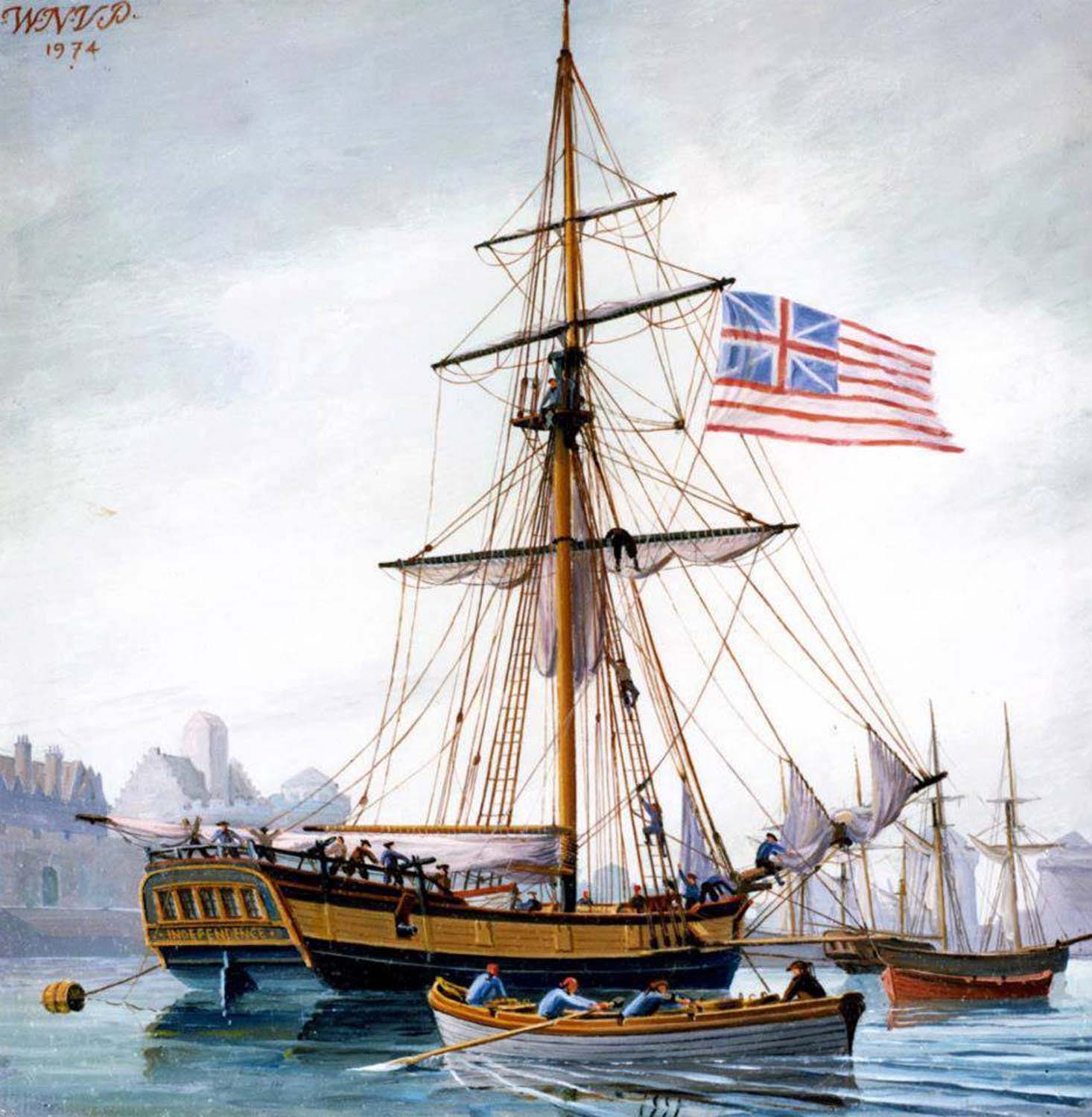
“We learn that Capt. Jabez Whipple of the privateer Independence[54] of this place has taken three valuable prizes viz a ship, Brig, and Sloop. And conveyed them to a safe port.”[55]
Newport, Sept. 9th
“On the 3rd of August Capt. Nathan Bull[56] of this place and Mr. Gideon Coggeshall[57] of Middletown with 12 other Americans made their escape from Halifax in an open boat in which they came around Cape Sable, crossed the Bay of Fundy and arrived at Beverly (Mass.) on the 14th of August from whence Capt. Bull was brought to turn by land last Wednesday in a very low state of health by whom and Mr. Coggeshall we learn that Halifax was left without one Ship of War that the whole force they could raise there including the militia would amount but to 1500 men, that a little time before they came away a number of transports had arrived from England which brought out 300 head of cattle but 93 of which lived through the passage, and these miserably thin.”
Sept 14th
“The privateers Montgomery[58] and Yankee Ranger[59] of this port have taken three large Brigs bound from the West Indies to England laden with Rum, Sugar, Coffee, and oil. They are all arrived at a safe port.”
“We learn that Capt. Samuel Dunn in a privateer …has taken a large Brig with 260 Hogshead of Rum.”[60]
Sept. 21st
“The privateer General Greene[61] of East Greenwich and the privateer Harlequin of Baltimore have taken a Jamaican ship of 310 tons and sent her into a safe port. Her cargo consists of 372 Hogshead of Sugar, 82 puncheons of Rum, 36 pipes and 4 Hogsheads of Madeira wine, 1800 pounds weight of (?) &c. This ship we hear sailed in company with a large fleet conveyed by two other Men of War, one of which was seen to leave them, the other said to be a dull sailor was to proceed with them to Europe.”[62]
Sept. 28, 1776
Extract of a letter from Montego Bay (Jamaica) dated August 6th and found on a prize ship lately captured:
“The confusion that we have been in here since you left the island on account of the slaves prevents my sending you the articles which you desired. God knows how the affair will end for they are daily impeached faster than they can be taken up, and what is amazing none have yet fled to the woods. It is said they have sent to St. Ann’s to procure a man to Command them there who was concerned in the last Rebellion, but I fancy he will be deterred on hearing of so many of their chief officers being taken up. I was obliged to go to Lucia on the information. Two of the Marrons were accused but it appears at present that only one worthless fellow who never staid at home and is detested by the rest has had any knowledge of it and they wish to have him punished if it can be proved that he has endeavored to represent them as inclined to serve the slaves. One cannot imagine how it has affected my (?) this year. I expect it will ruin me as well as some other planters bit I have not the spirits to write any more on the subject.”[63]
Extract from letter from Jamaica, Hanover Parish August 7, 1776
“The purpose of this is to acquaint you that we are still alive in this Parish. A most horrid conspiracy had been formed by the negroes to cut us all off to a man and even to a white female child. The women were [to be] forced to make concubines for the Ethiopians. Such were their intentions and Sunday the 21st of July. At night was the time appointed for putting the plot into execution, but Providence was kind enough to order it to be discovered the Monday before the 21st since which time military duty has been very severe. Martial law has been proclaimed and every person without exception is obliged to turn out. There is no intelligence of the negroes in the other parishes having joined them but suppose the massacre was to have been general throughout the island. Scarce anything is now going on in the Parish but taking up trying, hanging, and gibbeting alive though many have been acquitted.” [64]
Providence, Sept. 28th
“The Committee for building the two Continental Ships in this town call upon all the Officers and the Men engaged to serve on board there to repair immediately to their duty. The ships have fallen down and will be fit for the seas in a few days. And as this is the very critical season when the salvation of our country depends upon our utmost exertions the Committee cannot doubt but that the Officers and Men will use the greatest expedition in complying with this order.”
Jabez Bowen. Secretary.
Sept. 28th
Capt. James Munro[65] in the privateer Sally[66] of this place has taken a large Frigate built ship laden with Sugar, Rum, Cotton, Madeira wine, Whale oil & c. bound from Barbados to England…
Sept. 28th
Major Crane of this town[67] was wounded in the foot by a shot from the ship Rose commanded by the infamous Wallace when he was attacked and so roughly used in the East River a short time since…
The Asia Man of War[68] it is said has been much damaged by one of our Fire Ships in the North River.

Oct. 5, 1776
Capt. John Field[69] in the privateer Joseph of this place has taken a schooner bound from Nevis to London laden with Sugar and Rum, and Capt. Child[70] in the privateer Industry likewise of this place has taken a brig from Antigua travel[ing] to Ireland having on board Sugar and Rum. Both the above ships have arrived safe in Port.
Oct. 5, 1776
The same day (Sept. 29th) arrived here from a successful cruise the ship Columbus[71] [,] Captain Abraham Whipple[72] in the service of the United States having taken four prizes viz, a Brig from St. Croix bound to Scotland with 265 Hogshead of Rum, 1[?] and 1-2 Barrels of Sugar[,] a Ship from St. Christophers bound to London with 291 Hogsheads 59 Tierces, 23 barrels and 12 Kilderkins of Sugar and 15 Hogsheads and 3 barrels of Rum, a ship from Grenada bound to London with 300 Hogsheads of Sugar, 57 Hogsheads of Rum, 1 pipe and 2 hogsheads of wine, and some cotton[,] a Brig from Montserrat bound to Cork with 218 Hogsheads of Rum…Two of the above prizes are arrived at the Eastward…
Gazette of Oct. 12, 1776
Capt. Arthur Crawford[73] of this place has taken and sent safe into port a ship from London bound to Quebec with Blankets, woolen clothes, Irish linen sheetings, [?], shoes, stockings, Scot brandy, port wine,…cheese…
Her cargo when she sailed was estimated at Fifteen Thousand pounds sterling. He has likewise since taken two ships from Jamaica.
Oct. 12, 1776
Tuesday last (Oct. 8) arrived from a cruise the Sloop Providence[74][,] Capt. Jones in. the service of the United States. During her cruise she took 13 prizes most of them fishermen six of which she burnt or sunk after taking out their hands and ordered the others to different Ports. One of them has arrived in the Eastward…
Capt. Coffin[75] in his Favorite privateer of this port has taken a ship from Jamaica bound to London laden with Sugar, Rum, limes, Pimento &c. This prize has also arrived in a safe harbor.
Thursday last (Oct. 1) arrived the Privateer Industry[76] [,] Capt. Child of this port. About a fortnight since he fell in with a very large Jamaican ship mounting 10 carriage guns which he engaged for several hours but the seas running high and his vessel [taking] much water he could only bring two of his guns to bear and was finally obliged to quit her. Capt. Child had two men killed and five or six wounded.
We hear that a privateer belonging to Newport has taken two valuable prizes and sent them in at Eastward…
That the Cerberus Frigate[77] has this week taken two valuable prizes that had been captured by some of our Privateers. The hands that were on one of them escaped in their boat.
Oct. 19th 1776
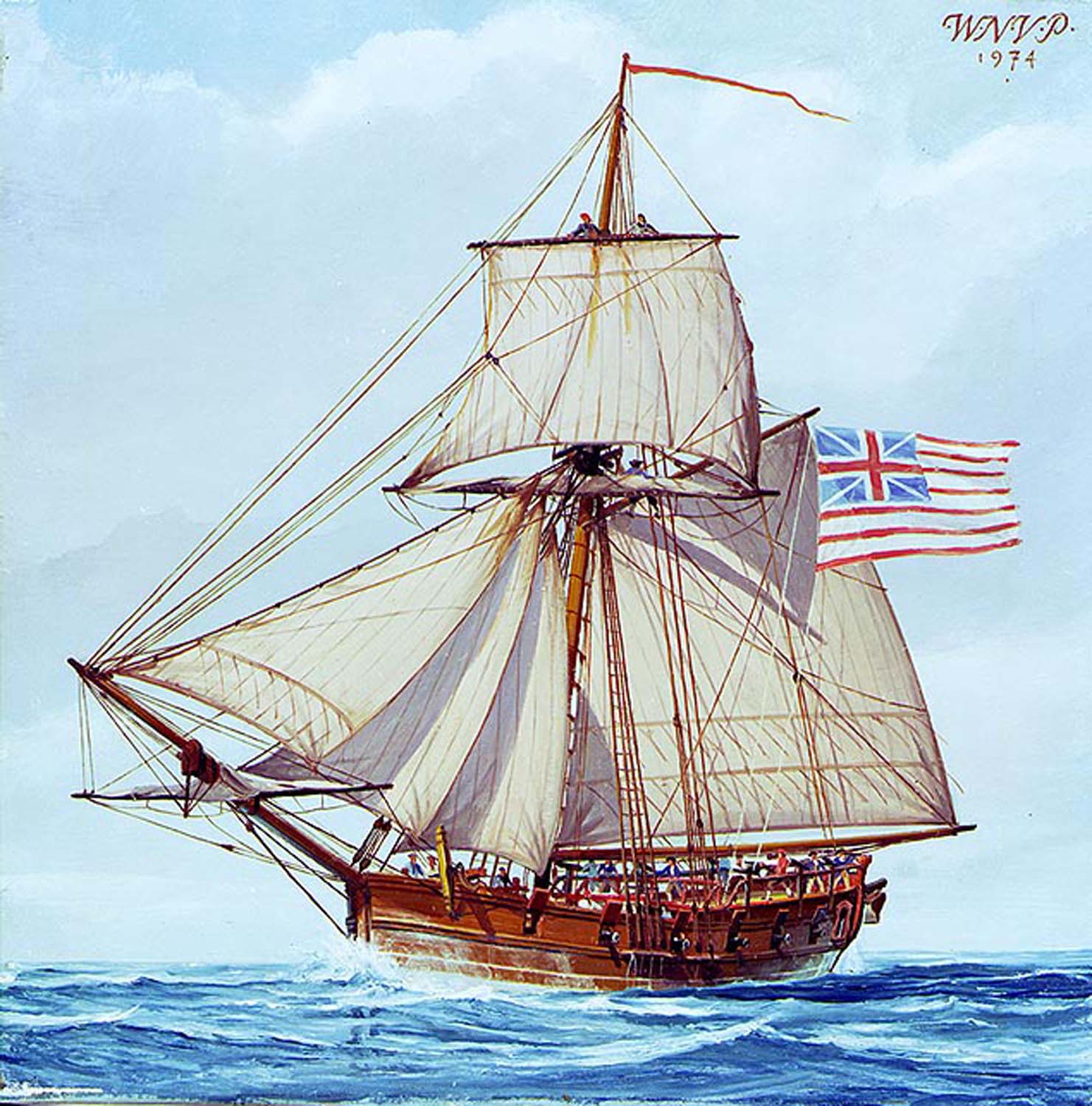
Capt. Coffin in the Privateer Favorite has taken and sent into port a schooner from Dominica bound to New Foundland …with Rum[,] Coffee[,] limes &c.
We hear the Brig Cabot[78] in the service of the United States has taken several prizes.
The Montgomery[79] and Eagle[80] Privateers have taken and sent into a Port, the Westward a Schooner from Capt. Nicholas Mole bound to Halifax having on board 9,000 gallons of molasses and 6,000 weight of Sugar. The privateer had been out but 24 hours when they took this vessel.
Oct. 26, 1776
The Brig Cabot Elisha Hinman[81] Commander, in the service of the United states has taken two ships from Jamaica bound to London laden with Sugar, Rum, and Indigo.
Capt. Stucy[82] in the Privateer Diamond[83] has taken a ship bound from Quebec to England laden with Coal, Coffee, kettles & c.
Capt. Christopher Whipple[84] in the Privateer Brig Gen. Putnam[85] has taken a ship bound from Antigua to England laden with sugar.
Capt. Pearce[86] in a Privateer belonging to East Greenwich has taken a shop bound from Nova Scotia to Jamaica laden with fish, boards, Spars & c.
Capt. Jouncy in the Privateer Washington belonging to the state of New York has taken a large Snow laden with provisions & c. bound from London to New York.
All above prizes have arrived in a safe port as also two others lately mentioned to have been taken by the Providence sloop of war in the service of the United states[,] John P. Jones Esq. Commander.
November 2nd
“Capt. Stacy in the Diamond privateer has taken a Brig having on boards 1500 (?) of codfish bound from Newfoundland to Spain and sent her into a safe port.”
“Capt. Pierce in a Privateer belonging to East Greenwich has taken a Brig laden with Sugar[,] Rum[,] Cotton[,] ..&c. bound…to Liverpool.”
“Another prize we hear has been taken by a Greenwich privateer. Both of them safe arrived.”
“We just learn that the Brig Cabot Elisha Himman Esq. Commander in the service of the United States has taken and sent in to a safe port a Ship from Jamaica bound for England mounting 16 carriage guns with 70 Hogshead od sugar on board.”
Williamsburg Va., November 3rd
“By the last South Carolina Gazette we learn that General Howe[87] and the brave Colonel Moultrie[88] were just returned to Charlestown from Georgia; and that there had been two skirmishes to the southward, in both of which our people were successful, but no particulars are mentioned; that a French sloop, with a valuable cargo of warlike stores, linen, wine, molasses, &c. was also arrived from Martinico.”
November 16th
“The Privateer June Capt. William Chase[89] will sail on Sunday night [Nov. 17]. The officers and Men are desired to repair on board.”
Philadelphia, November 21st
“A return of the killed and wounded in the engagement at Mount Washington is not yet arrived. It is certain the enemy have paid very dear for it, as, from the best accounts, it appears they have at least 2000 killed or wounded, which is a greater number than we had engaged.” [90]
Providence, November 23rd
“Capt. John Tillinghast[91] in the Privateer Sloop Independence[92] of 8 guns belonging to this place has taken and carried into a safe port a ship of 300 tons, mounting 16 carriage guns[,] 3 or 4 pounders[,] 8 swivels and having on board 30 men. Among them a Sergeant, Corporal, and 11 private soldiers. She was bound from Cork to the enemy at New York laden with a valuable cargo of provisions &c.
Capt. Tillinghast engaged her about 20 minutes and then boarded her when the men were seen drive from their quarters leaving the Captain alone to defend the Ship. Capt. Tillinghast was shot through the body by a musket ball but is recovered[,] three of his men were likewise wounded and two killed on board the prize, the Sergeant and two soldiers were killed and their Captain and six men wounded.
Another ship of 14 guns and a Brig mounting 8 swivels were in his company. Capt. Tillinghast exchanged a few Broadsides with the former after securing his prize when they thought proper to sheer off. The cargo of the prize consists of 1197 weight of Beef[,] 47880 weight [of] Pork[,] 14625 weight of butter[,] 48754 weight of Oatmeal, 140280 weight of Flour, 44800 weight of Bread, 1200 bushels of Peas, 1 Ton of Powder, a quantity of cannon ball[,] 6 tons of cordage &c.
A large number of provision ships were to leave Cork soon after the above vessel sailed most of them armed and to sail 10 or 12 in company.”
The names of the men killed on the privateer are John Angrers of Salem and Peter Ingerfield of Cambridge or Boston.”
November 23rd
“The Privateer Montgomery has taken a Schooner from New Foundland bound to Jamaica laden with fish and sent her into a safe port.”
November 30th
“Capt. West in the privateer Joseph[93] has taken a transport ship that left New York in company with 13 sail, all in ballast bound to Europe under convoy of the Men of War.
Capt. West has also taken a (?) man that had been captured by a Philadelphia privateer and twice retaken by the enemy.”
“Capt. Hacker[94] of the Sloop Providence in the service of the United States in company with the ship Alfred[95] has taken a ship from England bound for Quebec with 12000 suits of clothing, 4000 stands of Arms, a quantity of Powder and other worthwhile stores. Also a Brig from England with provisions to the amount of 6,000 Sterling. The Brig is arrived at a safe port and the ship was left in the company with the Alfred.”
New York, December 1st
“Thursday last, several transports full of troops and military stores passed up the East River into Connecticut Sound. At the same time, Mr. Peter Parker and Mr. Hotham with the Asia, Renown, and other men of war fell down to the Narrows, in order to join the above transports, as is supposed, about the east end of Long Island. Various conjectures are raised concerning their destination.”[96]
Hartford, December 2nd
“…We hear Generals Washington, Putnam, and Stirling are all at Elizabethtown, in New Jersey, with about 6,000 of the Continental troops, and that they have lately been reinforced with 12 or 1400 men from Pennsylvania and New-Jersy, and more were continually coming in to their assistance.”[97]
Newport, December 2nd
Last Friday [Nov. 29] 3 ships were seen cruising all day a little to the east of Sakonnet Point[98] and thence to westward and about sunset they stood off south.”
December 7th
“Sunday last (Dec. 1) 11 Sail of the Enemy’s Fleet left from New York and were discovered between Montauk Point and Block Island any by authentic accounts we have received we learn they consist of seven Ships from 40 to 60 guns and carry from 28 to 36 guns. They came to anchor the same evening near the West End of Block Island and next morning sailed up the western Sound where we hear they have been joined by upwards of 100 sail of transports.
By an express early this morning we learn that the above mentioned Fleet was seen last night and is supposed to be coming into the Harbour of Newport.
Saturday last, (Nov. 30) as the Yankee Ranger Privateer[99] was coming up the bay from a cruise she was overset near Prudence by a sudden gust of wind where five of her crew were drowned.”
Boston, Dec. 9th
“Last Saturday afternoon, Capt. St. Barbe in a vessel belonging to Newburyport arrived at Squam from Bilboa, in 30 days, with whom came passenger Mr. George Cabot of Beverly, Merchant, who informs that the Spanish and French ports are open to our Cruisers and their prizes, and that they permit the American vessels to carry the American flag in their ports…”[100]
December 14th
“Saturday morning last (Dec. 7) Commodore Sir Peter Parker[101] with about 70 Sail of Men of War and Transports came into our Bay from New York and anchored above the Harbour of Newport. On Sunday they landed a Body of Troops under the General Clinton and Piercy [102] who took possession of the Town[.] The inhabitants having previously determined that the place was not defensible against the enemy’s Shipping the few troops we had on the Island retreated to Bristol leaving behind them some pieces of Artillery. By the last accounts yet received the Enemy’s Troops do not consist of more than 5000 men among them are a number of Hessians[,] some horse and many Invalids. They are entrenching it is said at a place called Meeting House Hill three miles distant from Bristol Ferry.
From the first appearance of the Fleet the Militia and Independent companies of this State have been in motion and are since joined by a large number of Troops with some companies of Artillery from the neighboring states.
The readiness and zeal manifested on this occasion by the Troops of this and our Sister States reflect on them the highest credit and we hope will prove a happy presage of their success should the enemy attempt to gain a (?) in this Town or penetrate the Country.
We hear that the enemy’s troops were escorted into Newport by a set of well-known infamous Tories who have long infested that town and who may yet possibly meet with the fate justly due to their atrocious villanies.
We learn that two of the Enemy’s Frigates lie at or near Sakonnet passage another near Bristo; and a fourth at the north end of Prudence Island.
Some persons it is said have been taken up and committed to Gaol at Newport for the heinous crime of bearing arms against the King of Great Britain.”
Notice: December 14th
“DOCTOR MORGAN[103], Director-General, Hospital of the United States, wants a Quantity of old Linen, proper for Bandages and Lint, for which a good Price will be given by Dr. Joslyn[104] of East Greenwich.”
Providence, December 21st
“Wanted immediately for the Massachusetts Army, now serving in this State, the following Articles, viz Flour, Beef, Milk, Cyder, Peas or Beans, Soap, Vinegar, Wood, &c. Any person inclining to supply any of the above Articles are desired to apply to the Commissary of the above State, at his office in this Town.”
December 21st
“By some deserters from the ministerial fleet at Newport we learn that the troops lately arrived there consists of about 6000 men half of them Hessians and that it was reported on board the Fleet that they were soon to proceed to Boston through this town.
We learn from Newport that upon the arrival of a Ship there on Thursday last (Dec. 19) supposed to be from New York. The transports in the Harbour began to take on board Hay and Straw and it was whispered that Gen. Howe had met with a rebuff in New Jersey.
Th troops from the neighboring states continue to arrive here daily and last night came to town a company of volunteers from Salem.”
December 21st
“The Alfred Sloop of War in the service of the United States is arrived at an eastern port beside the valuable prizes lately mentioned to have been taken by her. She has captured three Coal ships that were bound for New York and a ship and Brig bound to Halifax with provisions. She also took a new Brig with provisions bound to Quebec which unfortunately ran ashore and was burnt.”
December 28th
“The very valuable prize ship lately taken by the Alfred Ship of War having on board a large quantity of Clothing, small arms& c. is arrived at a safe port.[105]
Another Prize taken by the Alfred is also arrived after having been retaken by a British frigate and recaptured by an American cruiser.”
About the Author
Robert A. “Bob” Geake is a Rhode Island public historian, author, and speaker whose work explores the state’s Revolutionary-era, Native American, maritime, and social history. He has written more than fifteen books on Rhode Island and New England, including From Slaves to Soldiers: The First Rhode Island Regiment in the American Revolution, A History of the Narragansett Tribe, and New England’s Citizen Soldiers: Mariners and Minutemen.
Geake has also contributed widely to public-history programs and publications, including Small State Big History, RI Footprints, and The Cocumscussoc Review. A past president of the Cocumscussoc Association at Smith’s Castle in North Kingstown, he remains active in historical education and interpretation, with particular attention to Rhode Island’s diverse Revolutionary War experience and the history of slavery in the state.
Notes:
[1] A 32 acre island off the coast of Newport, Goat island was settled in the 17th century, and gets its name from it first use by the settlers of Aquidneck Island. In the colonial period a defensive structure named Fort George was constructed. It was from this site that cannon were first fired in July 1774 at the Royal Navy Schooner HMS St. John, a British vessel that had captured cargos and forced men into service, or impressment entered Newport harbor. Under orders from Governor Stephen Hopkins, 13 shots were fired before the vessel retreated from the harbor. As British ships increased in the waters, the precaution was taken of removing the artillery from Newport to Providence in 1775.
[2] From the handwritten notes of James N. Arnold, Special Collections, James N. Arnold Collection 029-02 Providence Gazette, 1776.
[3] The notorious British Naval Officer Captain James Wallace (1731-1803) commanded the HMS Rose, a 20-gun Schooner that enforced the British blockade of shipping from Narragansett Bay, and harassed shoreline communities in these early stages of the War. Passes for travel on the Bay could be obtained, but it was still considered risky business. (R. Grandchamp, Rhode Island Militia Battles the Dreaded British Captain James Wallace on Prudence Island, (http://smallstatebighistory.com/rhode-island-militia-battles-dreaded-british-captain-james-wallace-prudence-island/ )
[4] A Bomb Brig was an 18th century warship with reinforced hulls to withstand the recoil from the heavy mortar guns they carried. These were typically used by the Royal Navy in assaults on shoreside communities throughout New England. The Continental Navy would famously capture the Bomb Brig HMS Bolton in an early engagement in April 1776. (Continental Navy Loses the Battle of Block Island, America 250 SAR, California Society, Sons of the American Revolution) https://www.californiasar.org/2024/04/continental-navy-loses-the-battle-of-block-island-2/
[5] Tenders are smaller, support craft for the larger vessels in a Fleet. Typically used to transport men or supplies between ships or back and forth from shore.
[6] Conanicut Island is the second largest island in the Bay and was the seasonal home of the Narragansett Tribe,, the First People of Rhode Island. During the Revolutionary War it was the site of Farmer James Eldred’s one gun on the island north of Potter’s Cove from which he fired cannonball and rocks liberally at passing British vessels. He was considered a nuisance by the fleet until one shot tore out a sail and a British setail was sent onto the island to find and spike the cannon. (Rosemary Enright and Sue Maden JHS 100 Years: Conanicut Island Under Stress and Attack, The Jamestown Press, May 10, 2012)
[7] Brenton Point currently holds 89 acres on the Southernmost tip of Aquidneck Island. Established and named for colonial Governor William Benton (1600-1674) who established a plantation on the Point. The original 2000 acres of his estate extended to the current Castle Hill, Hammersmith Farm, and Fort Adams. In the 18th century the waters around the Point were largely occupied by pirates and privateers, as well as slave ships that soon made Newport the hub of human trafficking in New England.
[8] This incident of Wallace’s raid on the third largest Island in Narragansett Bay was the third raid conducted by the British who stole livestock and provisions from the few inhabitants, even furniture in early raids. The response by the inhabitants and Rhode Island militia from Portsmouth and Warwick includes the first time that enslaved men were enlisted into the Island’s militia and fired upon British troops. For accounts of the incident and the role of black enlistees, see Robert Grandchamp, From Fence to Fence, the Battles of Prudence Island, (https://battleofrhodeisland.org/from-fence-to-fence/ ) and Jerry Cutter/Robert A. Geake The Settlement of Prudence Island and its Abandonment During the Revolutionary War. (https://battleofrhodeisland.org/the-settlement-of-prudence-island-and-its-abandonment-during-the-revolutionary-war/ ).
[9] The HMS Swan was a 14 gun Royal Navy sloop that routinely patrolled New England waters during this period. Commanded by Captain James Ayscough, it was part of the fleet alongside the infamous HMS Rose that disrupted American commerce.
[10] In January 1776 the General Assembly ordered that fortifications be constructed upon this peninsula of upper Narragansett Bay, and that a force of not more than 50 men be stationed with the Kent County regiment and Battery under command of Colonel John Waterman. (https://visitwarwickri.com/listing/warwick-neck-fortifications/508/). As the war continued and Rhode Island men were embedded in Continental units on campaign, the state began to rely upon militia from Massachusetts to help guard the shoreline from 1777-1779. See the author’s transcription of the journal of Noah Robinson, Fired a Gun at the Rising of the Sun, a soldier from Attleboro, Massachusetts who served two terms in Rhode Island as part of John Dagget’s militia from that town, including several months at Warwick Neck.
[11] The town of Warren on the East Bay was a bustling shipbuilding and trade community entering into the American Revolution. The conflict made the town a frequent target of British raids and intimidation, especially during the occupation of Newport. A particularly damaging raid came on May 25,1778 when British and Hession troops ransacked the town, burning the Baptist Meeting house and several dwellings and barns as well as boats that had been hidden along the Kickemuit River for use to transport troops in what became known as the Battle of Rhode Island. (https://www.townofwarren-ri.gov/explore/history.php ).
[12] The Providence Gazette, edition of January 13, 1776, Rhode Island Historical Society Microfilm Collection, Robinson Research Library.
[13] The Providence Gazette, edition of January 21, 1776, Rhode Island Historical Society Microfilm Collection, Robinson Research Library.
[14] The Strait of Gibraltar, the gateway to the Mediterranean ports, was almost universally called “the straits” in the 18th century maritime world.
[15] Captain Hugh Hill (1740-1829) was a celebrated privateer from Marblehead, who with his armed vessels the Pilgrim and Cicero, took numerous prizes that year of 1776. In one cruise alone, he took eight prizes in just six weeks. (Octavius Thorndike Howe, M.D. Beverly Privateers in the American Revolution, (Cambridge, The Colonial Society of Massachusetts, 1922) 330.
[16] William Pitt the Elder (1708-1778) was a British Whig statesman who served first in the Cabinet from 1756-176, and then as Prime Minister from 1766-1768. He was well-known for his oratory skills, a power he still held in the House of Lords during the months leading up the American Revolution.
[17] The Earl of Chatham, in his famous speech of February 1, 1775, outlined the ways in which he hoped to maintain America as a British colony, while addressing its concerns and offering concessions to the people. He hoped to reach “a true reconcilement” that would “avert impending calamities” and “stand an everlasting monument of clemency and magnanimity in the benignant father of his people.” (Dr. Robin Eagles, Background to the American Revolution, History of Parliament, https://historyofparliament.com/2025/02/11/background-to-the-american-revolution/
[18] The local name for St. Eustatius, the Dutch controlled island during the 18th century was a wealthy hub of trade and commerce. During the American Revolution, the island was an important supplier of arms and gunpowder. It secured its place in that conflict’s history when on November 16, 1776 the 14 gun American Brig Andrew Doria under command of Capt. Isaiah Robinson, entered the harbor below Fort Oranje flying the flag of the Continental Navy. It fired a thirteen gun salute to represent the thirteen colonies. Governor Johannes de Graeff responded with an eleven gun salute from the forts cannons, following protocol to acknowledge a non-sovereign flag. The response was the first international recognition of an American vessel carrying a flag of the revolutionary forces. (Geoffry M. Footner, USS Andrew Doria: The First to Salute, Naval Institute Press, 2022, 112-115.
[19] The Crawford family of Providence carried a long maritime history. Capt. Joseph Crawford Jr. was the son and namesake of a seafaring merchant. Capt. John Crawford ( 1742-?) was the son of the mariner Gideon Crawford (1708-1792), who was also active during the Revolutionary War.
[20] The Providence Gazette, edition of February 16, 1776, Rhode Island Historical society Microfilm Collection, Robinson Research Library.
[21] This 91-acre island sits just a mile and a half west of Prudence Island, but its steep cliffs and rocky shoreline have long kept it from permanent habitation. It has long been a protected wildlife sanctuary under the Narragansett Bay National Estuarine Research Reserve.
[22] Throughout the conflicts for Empire in which Great Britain engaged, a constant need for mariners, no matter how green, led to Royal Navy vessels chasing down merchant, whaling, and fishing boats throughout the Atlantic. Officers would then board and impress any able bodied seaman who held no proof of citizenship to another nation or held an official pass for passage, into forced service for the Royal Navy. More to fear, were the “press gangs” that haunted harbor taverns along the Eastern seaboard for the same purpose. (Gary Nash, The Urban Crucible, The Northern Seaports and the Origins of the American Revolution (Harvard University Press, 1986).
[23] The Providence Gazette, edition of February 24, 1776, Rhode Island Historical society Microfilm Collection, Robinson Research Library.
[24] Blue Rocks is situated off the waterfront of the historic “Point” neighborhood along Washington Street in Newport. It is also the site of the deliberate scuttling of five transport ships by the British to block the channel between Blue Rocks and Goat Island in order to prevent French Naval vessels from approaching the North Battery during events leading up to the Battle of Rhode Island in 1778. (Brody Karn, Shipwrecks off the Point-Law, War, and Legacy The Green Light, The Point Association of Newport, Fall 2025) https://thepointassociation.org/wp-content/uploads/2025/11/Fall2025FInal.pdf
[25] From the handwritten notes of James N. Arnold, Special Collections, James N. Arnold Collection 029-02 Providence Gazette, 1776.
[26] Bedloe’s Island, now known famously as Liberty Island for the statue it holds, is actually 5/8 of a mile from Manhattan. It’s earliest structure was a lighthouse, constructed by entrepreneur Archibald Kennedy after he purchased the island in 1746. He established a summer residence and was soon advertising the island as a romantic getaway. In 1756, Kennedy allowed use of the island for a smallpox quarantine location, something the island had been used for in an earlier outbreak. This may be why the Island was sold to the city outright two years later. By the time of the Revolution and New York’s occupation; the island was planned to house Tory refugees from the city, with the H.M.S. Eagle anchored offshore for protection.
[27] Triggered by a false alarm that a British fleet had entered Narragansett Bay on April 1st, an urgent military alert was issued along the coastline from Providence and Warwick to Barrington and Bristol on the East Bay. While the threat was a false alarm, legislators worked quickly to establish better defenses, including the construction of beacon poles and fortifications at selected sites in the coming months. The threat from the Royal Navy was also a key factor in the state’s break of allegiance from Great Britain on May 4, 1776.
[28] The pre-dawn battle of Moore’s Creek Bridge on February 27, 1776 is considered a minor skirmish in the Revolutionary War. Calls and taunts across the river by patriot militia and Scottish Highland guards led to a Highland charge by the sword wielding loyalists, who were met with a fatal barrage of musket and artillery fire. Two of the Loyalist leaders were killed with another captured. The battle scattered the Highland Regiment and some 850 of them were captured in the days and weeks after the battle. Most were paroled, but the remaining leaders were sent for imprisonment to Philadelphia.
[29] Brigadier General Donald McDonald was a Scottish Highland Officer and a career military man. He was commissioned by North Carolina’s Royal Governor Josiah Martin to recruit and lead a band of Loyalists. He was a British veteran of the French and Indian War, and early in the Revolution, served at the Battle of Breeds (Bunker) Hill. His capture made him prisoner for more than a year, yet he returned to the British Army after his exchange and continued to serve until the end of the war. (The Loyalist Leaders in North Carolina: Brigadier General Donald McDonald, The American Revolution in North Carolina, https://www.carolana.com/NC/Revolution/loyalist_leaders_nc_donald_mcdonald.html
[30] Brigadier General James Moore (1737-1777) came from a prominent North Carolina family who were steeped in politics. He organized the North Carolina Continentals and was a key Commander in the early years of the American Revolution. Moore was preparing his Regiment to march north and meet General Washington, when he fell severely ill, and died in Wilmington, North Carolina on April 15, 1777.
[31] Long named “Wickford” by the time of the Revolution, it continued to be called Updike’s Newtown in letters, diaries, and newspapers of the time.
[32] This was the H.M.S. Rose, a large frigate that carried twenty guns, commanded by the notorious Captain James Wallace. He used the Rose and other vessels to blockade Newport Harbor, effectively halt the legal maritime trade, and terrorize coastal communities by seizing supplies on water as well as land.
[33] While some refugees to British ships were sold by unscrupulous captains, many more would gain their freedom. Able bodied men were sent to be enlisted in the Ethiopian Regiment formed by Lord Dunmore. Others were evacuated to New York or Nova Scotia. Yet others became mariners.
[34] John Goodrich (1722-1785) was born in Virginia, and lived as a successful planter for British interests. He was reportedly uncommitted at the start of the American Revolution but was recruited by Lord Dunmore to become a Loyalist privateer. Goodrich by his own account believed that he had destroyed 500 vessels in service to the British Crown. He was captured on April 17, 1776 off the coast of North Carolina and briefly imprisoned there before being moved to Virginia. His holdings and houses were confiscated before he escaped from prison and soon operated out of New York. He and his five sons privateering fleet grew to four vessels during the course of the war, the largest being the aptly named Dunmore, carrying sixteen guns, and the smallest being the Fincastle with two guns. (James Tomey, The Virginia Navy in the Revolution, Arcadia Publishing, 2016) 98.
[35] Known today as Ocracoke Inlet, South Carolina.
[36] No such company existed. The writer may be referring to the Queens Rangers, a unit of Loyalist blacks who would take part in successfully defending their “Negro Fort” outpost against rebel forces at Kings Bridge, New York on January 18, 1777. (Harry Shenawolf, Negro Gort: Black Loyalists of New York, Revolutionary War Journal, July 28, 2025. https://revolutionarywarjournal.com/negro-fort-black-loyalists-of-new-york/
[37] Named for Capt. Richard Hobbs, the patent holder by 1680 with some 800 acres including Hobbs Hole Harbor, a body of water across the mouth of Tucker Creek as it enters the Rappahannock River. By the American Revolution, it was known as a “town of trade”. (Wesley E. Pippenger, Local Historian says he Knows the Origin of the Name Hobbs Hole, Rappahannock Times, October 11, 2022)
[38] Hugh Walker was a well-known Virginia patriot whose vessels helped supply the Continental Army, as well as being commissioned for the fledgling Continental Navy. The Black patriot mentioned in the account is likely a man known only as “Minny” in a suit brought by his owner Lucretia Pritchett, seeking reparations for his death. In the suit, Pritchett contends that Minny “voluntarily entered himself on board a vessel commanded by Mr. Hugh Walker,” and that in Walker’s service had “bravely and successfully exerted himself against the enemy, until he was unfortunately killed.” Minny’s acts of heroism were key in Pritchett’s claim that since the death of her husband Joseph, her estate was “deprived of a valuable slave.” The Virginia Legislature ultimately paid her 100 dollars, as Minny had “behaved with uncommon bravery in an engagement with a piratical tender, and was killed by the enemy.” (Adam McNeil, Black Patriotism and Black Death in the Aftermath of the American Revolution, Black Perspectives, October 16, 2019) https://www.aaihs.org/black-patriotism-and-black-death-in-the-aftermath-of-the-american-revolution/
[39] Capt. James Mugford was commissioned as Captain in the newly formed Continental Navy in 1775. He was given command of the schooner USS Franklin out of Boston, Massachusetts. In May 1776, as the article indicates, the Franklin captured the British supply ship Hope on open water and carried her into Boston Harbor despite the presence of a British Fleet in the outer harbor. Having been unmolested on entering the harbor, when he returned to his ship the Franklin via the Lady Washington, both ships were converged upon by thirteen enemy vessels. In the fierce fighting that followed, Mugford was fatally shot by a musket ball, and died pleading with his lieutenant to persevere in the fight and not give up the vessel. The Americans in fact, did beat off the attack and forced the British vessels to withdraw. Capt. Mugford was brought ashore and buried in Marblehead, Massachusetts. (Frank Moore, Diary of the American Revolution, Vol. 1 1859)
[40] Even while reporting heroic actions of black Americans, newspapers like the Providence Gazette and other cities in the newly formed United States routinely printed advertisements for the individual sale, public auction, and reward for the capture of escaped enslaved individuals throughout the war. Rhode Island would only pass a gradual emancipation act in 1784, the year after the conflict ended.
[41] Gwynn Island in the Chesapeake Bay and the state of Virginia, lying off the Middle Peninsula. That summer, Lord Dunmore had entrenched himself on the island with 100 troops of the 14th Regiment, 100 marines, and over 150 volunteers from Norfolk, 50 seamen, and roughly 300 Africans used for building fortifications and other hard labor.
[42] General Andrew Lewis (1720-1781) was commander of the Virginia militia and well known at the time for his role as commander of the militia force that fought Chief Cornstalk and the Shawnee in the Battle of Point Pleasant in the Ohio Country on October 10, 1774. In this instance he commanded the forces which established an artillery battery on Cricket Hill, from which to assault Dunmore’s encampment and ships on July 9, 1776.
[43] Lewis Whiting first served as 1st Lieutenant of Capt. Samuel Colwell’s Company, John Smith’s regiment which marched on the alarm of April 19, 1775. Also served as 1st Lieutenant in Capt. James Metcalf’s company, and joined Col. Reed’s encampment at Roxbury, December 10, 1775. Raised a company in Wrentham and commissioned as their commander in February 1776. Listed as such in the “Return of the Names of the Men…in Capt. Lewis Whting’s company in Col. Wheelock’s Regiment,” Ticonderoga, August 1776. (Massachusetts Soldiers and Sailors, 176)
[44] The Regimental Book of the Rhode Island Regiment includes a 40 year old laborer from Glocester named Joseph Mith who enlisted in May 1781 for three years. He died December 29, 1781. (Bruce C. MacGunnigle Regimental Book, Rhode Island Regiment for 1781 &c., 40, 75)
[45] Col. John Paterson was commander of a regiment of 496 men from Berkshire County, Massachusetts. The regiment took part in the Siege of Boston, the Battle of Bunker Hill, and the majority of major actions of the Northern campaign throughout the war. In 1778 he was appointed Commander of West Point and served in that capacity until 1781. Five years later, he famously came out of retirement to assist in the quelling of Shay’s Rebellion. (Lenox History, Revolutionary War Heroes-Major General John Paterson, August 27, 2014) https://lenoxhistory.org/revolutionary-war-through-civil-war/revolutionary-war-heroes-major-general-john-paterson/
[46] Some 400 prisoners were taken in the failed attack on Quebec, December 31, 1775. Approximately one hundred Rhode Islanders who had largely volunteered from gathered forces in Boston, were held prisoner for several months.
[47] The sloop Montgomery was owned by Providence merchant Nathaniel Greene and eleven other investors. The sloop was outfitted with ten guns and manned by sixty mariners. (Sidney S. Riders List of Rhode Island Privateers, handwritten notebook, Rhode Island State Archives).
[48] Ibid.
[49] The disruption of trade and shipping to and from the West Indian islands by commissioned privateer vessels in the spring and summer of 1776 meant that shortages by the second year of the American War of Independence were causing a major impact on the islands populations, particularly on Barbados and Jamaica. As shortages of food and supplies increased, the fear of famine became very real. Goods normally shipped from North America dwindled to little traffic, and more urgently, the fear of an uprising among the enslaved population began to panic planter society. In Barbados, of the estimated 70,000 to 75,000 inhabitants at the time of the conflict only 15,000-20,000 were among the white population. Jamaica held an even high percentage of people of color, with an estimated population of 192,000 enslaved blacks and multiracial individuals. There were places on the Island where whites were outnumbered by 10-1. The fear and dread of the planters nearly reached fruition in July of 1776.
[50] As copied in the handwritten notes of Janes N. Arnold from the Providence Gazette August 10, 1776. James N. Arnold Collection, 029-02, Box 21, Folder 1776,Special Collections, Providence Public Library.
[51] Ibid.
[52] Ibid.
[53] The Joseph was a small schooner owned by Nathaniel Greene and five others. She carried six guns and was manned by a crew of forty-five (Sidney S. Rider’s List of Rhode Island Privateers, handwritten notebook, Rhode Island State Archives).
[54] The sloop Independence was registered in Providence on 24 July, 1776. It was owned and commanded by Jabez Whipple.
[55] As copied in the handwritten notes of James N. Arnold from the Providence Gazette, September 7, 1776. James N. Arnold Collection, Special Collections, Providence Public Library.
[56] Capt. Nathan Bull was a Newport mariner who operated several vessels transporting goods and flags of truce (holding prisoners for exchange) including the sloop Dove during the war. In April 1776 the Dove with Bull in command, was taken by the British Royal Navy ship Maidstone while returning to Rhode Island from the Caribbeans. His escape precludes the British taking of Newport in December 1776, after which, Bull often acted as a liaison, traveling between the island and mainland with flags of truce to conduct negotiations.
[57] Gideon Coggeshall (1726-1801) was a well-known mariner and member of a prominent Quaker family from Middletown, Rhode Island. His son Timothy Coggeshall (1753-1794) was also a mariner, merchant, and shipowner. While this is the only known reference to Gideon Sr., having involvement in the war, a relative John Coggeshall was expelled from Quaker Meeting for his involvement in the Revolutionary cause, and in 1782, a Gideon Coggeshall, likely a grandson, enlisted at aged 17. (WikiTree Family Tree, Ancestors Family Search, RIHS Enlistments, Muster, and Size Rolls of recruits enlisted to serve in the Rhode Island Regiment the campaign of 1782 Document 14, https://www.rihs.org/the-revolutionary-war-soldiers-index/coggeshall-gideon/
[58] See footnote VII.
[59] The sloop Yankee Ranger was owned by Joseph Tillinghast, John B. Hopkins, John Brown, and others. One document shows the sale of a 1/16th share of the vessel. She carried four carriage guns (2 pounders) and six swivel guns with a crew of twenty to twenty-five men. She successfully captured three prizes in August 1776 under command of Captains John Warner and Samuel Tripp. The sloop was taken out of commission in June 1777.(Naval Documents of the Revolutionary War, Volume 6, ) https://ibiblio.org/anrs/docs/E/E3/ndar_v06p04.pdf
[60] As copied in the handwritten notes of James N. Arnold from the Providence Gazette, September 14, 1776. James N. Arnold Collection, 029-02, Box 21, Folder 1776, Special Collections, Providence Public Library.
[61] The sloop General Greene was owned by Silas Casey, Jacob Greene, Griffin Greene and four others. She carried sixteen guns and a crew of thirty mariners. (Sidney S. Rider’s List of Rhode Island Privateers, handwritten notebook, Rhode Island State Archives).
[62] As copied in the handwritten notes of James N. Arnold from the Providence Gazette, September 24, 1776. James N. Arnold Collection, 029-02, Box 21, Folder 1776, Special Collections, Providence Public Library.
[63] Ibid.
[64] Ibid.
[65] Captain James Munro (1747-1814) was a prominent providence privateer, commanding at least seven ships during his career. In April 1776 he was commissioned as commander of the Sally, whose first prize was the British Brig Agnes in September of that year, and soon after, the frigate Blaze Castle. Munro brought the captured vessel back to Providence and ultimately sold the ship to John Innes Clark and Joseph Nightingale of Providence, who outfitted her with twenty six ponder cannons. Unable to leave the harbor because of the British occupation of Newport, the privateer languished until a daring escape by Munro in November 1777 was perpetrated under cover of dark skies and a fair wind. The Blaze Castle brought provisions of coal, wine and dry goods to the West Indies, but was captured on one such voyage in June 1778 by the HM frigate Unicorn. Munro was taken prisoner but released later that year and made his way back to Providence. The following June, he took command of another privateer, the brig Saratoga, with sixteen guns. In August 1779 however, after the successful capture of other vessels, the Saratoga was captured and her crew imprisoned on a prison ship in New York Harbor. On October 9, 1779 Munro escaped from the prison ship Old Jersey and made his way to Washington’s headquarters to deliver intelligence about the British forces occupying the city. (Mark E. Monroe/Colin Munro, James Munro, American Naval Sailor, Three Decks Forum, https://threedecks.org/index.php?display_type=show_crewman&id=20798
[66] Owned by John Brown, the sloop Sally was outfitted with ten, 6 pound cannon. Along with the sloop Diamond, the Brig Marlborough, and other vessels owned or invested with, Brown was one of the most successful owners of privateering vessels from Providence. The Diamond alone, under a “Capt. Stacey” captured twelve prizes in 1776 alone, though armed only with six four pond cannons, and ten swivel guns for a crew of thirty to forty men. (Christian McBurney, Providence Merchant John Brown Gets Rich Privateering in 1776 and 1777, Online Review of Rhode Island History, 2023, https://smallstatebighistory.com/providence-merchant-john-brown-gets-rich-privateering-in-1776-and-1777/
[67] Major John Crane (1744-1805) was a carpenter and member of the Sons of Liberty in Boston before moving to Providence in 1774 due to the Boston Port Act. Once in town, he was commissioned a Lieutenant of Artillery and commanded the newly formed Rhode Island Train of Artillery. In Boston, this unit became part of the Continental Artillery Regiment. Crane took part in the Battle of Bunker Hill and was commissioned as Major for Artillery regiment commanded by Henry Knox at the close of 1775. The article relates to the incident off Corlear’s Hook, September 14, 1776 when he lost a portion of his foot from cannon shot by the HMS Rose. Though reportedly nearly dying from lockjaw, Crane recovered and was promoted to Colonel and command of the 3rd Continental Artillery regiment, a position he held until the close of the war. (https://www.wikitree.com/wiki/Crane-2444 ).
[68] The HMS Asia was a 64-gun, third rate ship of the line of the Royal Navy, launched in 1764. She played a prominent role in the early part of the American Revolution, first serving as the transport for 500 Royal Marines sent to New York City in 1774 to quell tensions there. She arrived in New York on December 4, remained as part of a flotilla under Admiral Richard Howe. In January 1775 she was assigned to Vice-Admiral Graves Northern Squadron under command of Captain George Vanderput. The Asia returned to New York waters and provided protection to merchant ships, in particular, escorting the Duchess of Gordon on which Royal governor William Tryon had sought refuge. Aboard the Asia, Tryon and Loyalist plotted the assassination of George Washington, a plot that was discovered and cost the life of Thomas Hickey, an Irish-born member of Washington’s Life Guard who had entered into the plot. The Asia later took part in the Battle of Brooklyn in 1776, and later in the year was damaged by fire in an engagement. She was retired from the main theater of war, and by 1778-1779 was escorting vessels to East India. (Naval Documents of the American Revolution, Volume 1, American Theater, Dec. 1, 1774 – Sept. 2, 1775),(Brad Melzer, The First Conspiracy: The Secret Plot to Kill George Washington Flatiron Books, 2019), (Brooklyn Citizen, October 10, 1897, p. 13).
[69] Captain John Field (1738-1808) was a Providence mariner and Master of the privateer Joseph which had several successful cruises.
[70] Captain Thomas Child took command of the privateer sloop Joseph after her initial voyage in April 1776 under Capt. James Munro. Child successfully captured British prizes into the fall of the year.
[71] The Colombus was a 20-gun armed ship commissioned by the Continental Navy in 1776.
[72] Captain Abraham Whipple (1733-1819) was a lifelong mariner, becoming Captain of a merchant vessel at a young age, he then became captain of the privateer Gamecock, and found a successful career, capturing twenty-three French vessels during the French and Indian War. Whipple was among those who led the boats on the attack against the HMS Gaspee as she lay grounded above the Providence River, and in 1775 was appointed a Commodore of the Continental Navy and assigned captain of the Colombus. He claimed to have “fired the first shot on water in defiance of the British flag”, and reputedly ran a tight ship. In July 1775 he was summoned from his vessel to Philadelphia to answer to charges filed by his junior officers. He was found guilty of nothing more than “a rough and indelicate mode of behavior” toward his Officers, and was encouraged to “cultivate harmony” with them in the future. By 1779 he commanded a squadron defending Charlestown Harbor aboard his flagship Providence. Abraham Whipple would be captured at Charlestown and be held as prisoner until the close of the war. On returning to Rhode Island, he farmed in Cranston for several years before moving to Marietta, Ohio where he died in 1819. (Rick Stattler, Historical Note, Abraham Whipple Collection, Rhode Island Historical Society, MSS 802)
[73] Capt. Arthur Crawford was a Providence-based privateer and Master of the Sloop of War Hawke. In October 1776, he filed for the cargo of the Thomas, as shown: said Mariner Commander of the Private Sloop of War called the Hawke fitted out from Providence afor[e]said and duly Commissioned with Letters of Marque and Reprisal to Cruize against the Enemies of the United States of America, Comes into this Honble Court and for himself and in Behalf of the Owners of and the Officers and Mariners belonging to said Sloop, gives your Honor to understand and be informed That on theTwenty first Day of September AD 1776, being on a Cruize against the Enemies of the said United States on the High Seas, in Latitude 45″. and Longitude 48″ he took and captured the Ship called the Thomas burthened Two Hundred Tons or thereabouts late Commanded by one Thomas Bell with her Appurtenances together with her Cargo consisting of Blankets, Coarse woolen Cloths, Irish Linnens, Sheeting, Shoes, Stockings, Dowlass, Brandy, Port Wine, bottled Porter, Cheese ~c.&c.&c. bound from London in the Kingdom of Great Britain to Quebec in the Province of Canada; and which said Ship with her Appurtenances together with her Cargo before the time of Capture belonged to and were the Property of some of the Inhabitants of the Island of Great Britain, and were designed to supply the British Fleets and Armies now acting against these United States; and
that your Informent hath sent the said Ship into the port of Providence within your Honors Jurisdiction. Wherefore he humbly prays that your Honor would take the Premises into Consideration, and order the proper Process and Monitions to issue as are in such Cases required by Law or that
your Honor would otherwise Proceed as to Justice and Right…” (Naval Documents of the American Revolution, Vol. 6, 1175)
[74] The renowned Sloop of War USS Providence was originally built and launched as the Katy in 1775, with Capt. Abraham Whipple as commander and assigned the task of cruising Narragansett Bay in protection of coastal shipping. She sailed from Providence late in November 1775 with a crew put together by Commodore Esek Hopkins. On her arrival in Philadelphia on December 3rd., she was formally renamed the USS Providence of the Continental Navy, and Capt. John Hazard was placed in command. Known for speed, and carrying twenty guns, the Sloop of War joined a small fleet under Hopkins that captured several prizes before returning in late spring. On May 10, 1776, the command of the USS Providence was given to Lieutenant John Paul Jones with the following orders from Commodore Hopkins: “You are to take command of the sloop Providence and put her in the best condition you can – and you are to take soldiers abord that belong to General Washington’s army and carry them to New York as soon as you can.” She was to have a successful career as both an escort and a privateer. On an independent cruise that year, she netted some nine prizes, and sank several enemy vessels before her return to Providence on October 8th. She remained at anchor on the Providence River while the British took Newport, but broke the enemy’s blockade in February 1777 under command of Lt. Jonathan Pitcher and sailed to New Bedford. From there the Providence sailed to Cape Breton and captured a transport vessel with two officers and twenty-five soldiers of the British army, as well as the crew. She made two more successful cruises under command of Capt. John Peck Rathbun. In mid-January 1778, she set out for New Providence in the Bahamas. She successfully attacked the fort at Nassau, spiking the guns, carrying off some 1600 pounds of gunpowder, and releasing 30 American prisoners of war. By January 30th, she had captured another six vessels, two of which were burned, three others manned and sailed away, while a 16-gun ship was brought back to New Bedford. The privateer remained active in 1779, ordered to take a cruise off the Massachusetts coast in early April, then sailing south, captured the 12 gun Brig HMS Diligent in May. The USS Providence was assigned to Commodore Saltonstall’s squadron, which departed Boston on July 19, 1779 as part of the Penobscot expedition. She was skuttled by the crew at the end of that campaign to avoid her from falling into British hands. (Frank N. Rathbun, “Rathbun’s Raid on Nassau”, United States Naval Institute Proceedings 1970, 40-47. Letter from Commodore Esek Hopkins to Lieutenant John Paul Jones, Naval Documents of the American Revolution, Vol. 5, 27. Naval Documents of the United States, Vol. 11, European Theater, Jan. 1, 1778-March 31, 1778, American Theater, Jan. 1, 1778 – March 31, 1778).
[75] Captain Abner Coffin was a Providence -based privateer and Master of the privateer Ship Favorite and others during the American Revolution. (Naval Documents of The American Revolution, Vol 6, American Theater, 89, 1349).
[76] The two-masted Brig Industry had an investment of sixteen owners, not uncommon in the world of merchant shipping but brought over to the privateering enterprises that were taken at the beginning of the war. Merchant John Brown had a 3/16ths interest in the vessel and its cargo. (https://smallstatebighistory.com/providence-merchant-john-brown-gets-rich-privateering-in-1776-and-1777/ ).
[77] The HMS Cerberus was a 28-gun Frigate that holds the distinction of having carried three British Generals – John Burgoyne, Henry Clinton, and William Howe into Boston harbor just weeks after the skirmishes at Lexington and Concord. She lent support to the Artillery during the Battle of Bunker Hill, and as the article describes, recaptured vessels with engagements on the high seas. When the Cerebus was scuttled by her crew to avoid her from falling into French hands at Newport, Rhode Island in 1778, it closed a twenty year career for the warship. (HMS Cerebus, the Warship that Brought Burgoyne, Clinton, and Howe to the Colonies, New York Almanac, October 8, 2025, https://www.newyorkalmanack.com/2025/10/hms-cerberus-burgoyne-clinton-howe/ ).
[78] The USS Cabot was a 14-gun Brig of the Continental Navy. One of the first vessels authorized by Congress for purchase, along with the Brig Andrew Doria. The Cabot was placed under command of Capt. J. B. Hopkins, outfitted with 14 six pound cannons, and assigned to the fleet of Commodore Esek Hopkins. She joined in the attack on Nassau in March 1776, also taking part in the capture of the vessel New Providence. The Cabot was the first to fire in the Battle of Block Island the following month. In June she set out on a cruise, capturing several prizes well into the fall. In 1777, the command of the USS Cabot was assigned to Capt. Joseph Olney. Her last journey came when she st out of Boston in early March and encountered the British Frigate HMS Milford. The larger ship set chase to the Cabot and eventually ran her aground near the mouth of the Chebogue River, in Yarmouth County, Nova Scotia. Olney and his crew were able to escape the ship and climb into the woods. The British recovered the vessel and put her to use for the Royal Navy. (Naval Documents of the American Revolution, Vol. 2, American Theater, Sept. 3, 1775 – October 31, 1775, 441. Naval History and Heritage Command, Cabot I (Brig) 1775-1777, https://www.history.navy.mil/research/histories/ship-histories/danfs/c/cabot-brig-i.html ).
[79] The ten-gun Sloop of War Montgomery was initially owned and outfitted by Providence merchant Nathaniel Greene and eleven other investors. On August 8, 1776, William Rhodes petitioned the Commission to be granted to him and other owners: “Sir, We the Subscribers all of Providence in the State of Rhode-Island and Providence Plantations, Merchants, request your Honor to grant a Commission, or Letters of Marque and Reprisal to William Rhodes Commander of the Private Sloop of War Montgomery of which we are Owners,2 She is burthened about Sixty Tons, carries Ten Carriage Guns Four Pounders and Two Pounders, and Ten Swivel Guns, manned with Sixty Men, and fitted with a suitable Quantity of Muskets, Blunderbusses, Cutlasses, Pistols, Powder, Ball and other Military Stores. She hath on board Twenty barrels Beef and Pork Forty Hundred-weight of Bread, Two-barrels of Flour, with some Rice, Beans, Pottatoes &c. Samuel Warner ー is First Lieutenant, Thomas Ruttenber Master and Joseph Bucklin junr. Second Lieutenant. We are with great Respect Sir [&c.].” (navydocs.org https://www.navydocs.org/node/6647 ).
[80] The privateer Eagle under command of Capt. Isaac Field, “belonging to John Mathewson and others in Providence” was commissioned in 1776, and “mounting ten carriage guns (-) sixty-five men to fit out and set forth the Schooner in a warlike manner and by and with the said schooner and the crew thereof by force of arms to attack ships and take the ships and other vessels belonging to the inhabitants of Great Britain, or any of them with their tackle, apparel, furniture and loadings on the high seas…” The Continental commander John Paul Jones famously followed the Eagle with his Sloop of War Alfred in November 1776, having failed to find any men in Newport willing to sign aboard. He met the privateer anchored off Tarpon Cove, laid his vessel alongside, and took twenty-four men off and impressed them into his crew. Such was the popularity of signing aboard a privateer for Rhode Island’s young men of the sea. (Richard and Gloria Schmidt, Rhode Island Privateers: Isaac Field and the Eagle, Portsmouth History Notes, March 23, 2024, https://portsmouthhistorynotes.com/2024/03/23/rhode-island-privateers-isaac-field-and-the-eagle/ ).
[81] Within the first to be commissioned as an officer in the Continental Navy, Elisha Hinman (1732-1807) had been a mariner since the age of fourteen, and at twenty was the captain of a merchant vessel. As the Commander of the USS Cabot, he captured five British ships sailing from Jamaica on his maiden voyage. He was commissioned as Captain of the ship Alfred, and with that vessel captured one merchantman, and two larger ships off Jamaica, which he ferried to France for sale by an American agent. On his return voyage however, he was overtaken by two British vessels and taken prisoner. Incarcerated at Fortune prison, he bribed guards and walked away after just five days, making his way to Dunkirk by mid-August and waited for a ship he could board for home. He returned aboard the Sloop of War Providence in August 1778. He was at sea again by 1780, in command of the gunboat Dean, on which he served until the close of the war. It was found after the war, that the government owed him upwards of $ 3,000.00 in back wages, but issued him a promissory note rather than any funds. When the British attacked New London, Connecticut in September 1781, Hinman lost all his family’s property. In desperation, he was forced to sell the note for three shillings on the pound. He wrote as a Revolutionary veteran to John Adams in 1798, begging for command of a revenue cutter, citing his former service, his continued good health, along with his increasing financial need. He was given command of the Federal revenue cutter Argus, after the death of its Captain, a position he held until 1803. (Biography of Captain Elisha Hinman, U.S. Navy, Revolutionary War, Military Roll of Honor. Pension application of Noah Walrond, October 24, 1832, Fold3, https://www.fold3.com/memorial/527301826/captain-elisha-hinman/gallery#gallery ).
[82] Misspelling of Captain Thomas Stacy, (sometimes spelled Stacey). the Rhode Island privateer. ( Christian McBurney, Providence Merchant John Brown Gets Rich Privateering in 1776 and 1777, Journal of the American Revolution, October 18, 2022)
[83] The 6-gun Sloop of War Diamond was registered in Providence on July 1, 1776 under command of Capt. William Chace. An article in the Gazette of August 17th reported the taking of a British vessel of distinguished passengers: “Wednesday last arrived here from a short Cruiz of one Month the Privateer Sloop Diamond, Captain William Chace, of this Port, and brought in a Prize Ship from Dominica, bound to Bristol [England]. The following passengers were on board, viz, a Youth about 7 years of age, Son to the Governor of Dominica; Mr. Hutchinson, a Member of the Council of that Island; and Mr. Charles Hobby Hubbart of Boston: The[se] Gentlemen arrived at Antigua from England December last, in a Transport ship, where on Account of his Attachment to the American Cause, he was apprehended and confined to jail upwards of six Months, [a] great Part of that Time in a dungeon”. (Maureen Taylor, Revolutionary War Privateers 1774-1783, Rhode Island Roots, June 2026, 100-112).
[84] Capt. Christopher Whipple is mentioned in the orders of the Continental Congress as one of two Officers who would be given command of two Continental vessels that were to be built in 1775. Commodore Abraham Whipple would command the larger ship, and Capt. Christopher Whipple the smaller vessel. Due to the urgency to respond to the infestation of ships in the Atlantic corridor, Commodore Whipple was given the Katy, built and outfitted by merchant John Brown to set out as soon as ready to protect the shipping routes. Capt. Christopher Whipple would then have been given command of the Sloop of War Washington, chartered on June 12, 1775. Given orders to challenge the British Naval presence in Narragansett Bay , the two vessels had numerous encounters, the Washington sailed as part of Commodore Whipple’s small but successful fleet. Nonetheless, she returned to port in poor condition. I could find no documentation as to when Christopher Whipple was assigned to the Gen. Putnam but for the documentation here.
[85] The armed schooner General Putnam was originally a Providence based privateer owned and outfitted by Providence merchants John Jenckes and Nathaniel Greene, along with eight other investors. Not to be confused with the later privateer built in Connecticut in 1778. (Gardner W. Allen, A Naval History of the American Revolution ,Chapter 3: Washington’s Fleet 1775-1776. ).
[86] Capt. Job Pearce sailed out of East Greenwich with the private 24- gun Sloop of War, Greenwich, owned by merchants Jacob Greene and Silas Casey, with other Greene family members investing as well. On October 21, 1776 the Greenwich arrived in Newport with the prize of a 300 ton ship, laden with timber and fish from Nova Scotia. Ten days later the sloop brought a second prize-a captured Brig, up the western passage of Narragansett Bay. (Naval Records of the American Revolution, Vol. 6, American Theater, August 1, 1776-October 31, 1776, 1360-1361, Sidney S. Rider, Notebook of Rhode Island Privateers, Rhode Island Archives).
[87] Major General Robert Howe ( 1732-1786 ) became the colony of North Carolina’s highest ranking officer during the Revolutionary War. Having trained the Brunswick Militia, he was appointed commander of the Second North Carolina Continentals. Howe and his men are credited for their role in the Battle of Norfolk and the defeat of Lord Dunmore. In 1777, he led North Carolina troops to meet Major General Charles Lee, then commander of the Southern Campaign. Howe himself was given that post later in the year, and in 1778 marched the troops to the Georgia -Florida border to attack British troops at St. Augustine. The disastrous campaign ended after several months of futility, with Howe retreating north in late summer to aide in the defense of Savannah, which was lost in December 1778. ( Richard Carney, Robert Howe (1732-1786), North Carolina History Project, https://northcarolinahistory.org/encyclopedia/robert-howe-1732-1786/ )
[88] William Moultrie (1730-1805) was commissioned as Colonel of the 2nd South Carolina regiment of Provincial troops in 1775. The following year, his defense of a small fort on Sullivan’s Island prevented the fleets of Sir Henry Clinton and Sir Peter Parker from infiltrating the harbor and taking Charleston. After this engagement he was promoted to Brigadier-General. He successfully repelled the British again at Port Royal in 1779, but was captured when Charleston finally surrendered in 1780. He was then placed in charge of the American prisoners of war and frequently negotiated on their behalf before he was released in a prisoner exchange in 1782. That year he was promoted to Major General before the close of the war. (C.L. Bragg, Crescent Moon Over Carolina: William Moultrie and American Liberty, Columbia, University of South Carolina Press, 2013).
[89] William Chace was owner and commander of the privateer Diamond registered in Providence on July 1, 1776. He appears in several notices of prizes taken that year in the Providence Gazette, and in the correspondence of Governor Nicholas Cooke, who wrote to Stephen Hopkins and William Ellery that “since my last, two very valuable prizes have been taken here, by the sloop Diamond, Capt. William Chace, laden with sugar, coffee. Cotton &c, as also a bark, laden with rum and sugar taken by the sloop Montgomery.” (Maureen Taylor, Revolutionary War Privateers List 1774-1783, Rhode Island Roots, June 2026, 100-112, Revolutionary Correspondence, Governor Nicholas Cooke, 161).
[90] Providence Gazette, December 14, 1776. Rhode Island Historical Society Microfilm Collection, Robinson Research Library.
[91] Capt. Jonathan (John) Tillinghast was the brother of the more famous Capt. Joseph Tillinghast of Providence, both from a longstanding seafaring family. (RIHS Tillinghast Papers)
[92] The sloop Independence was registered in July 1776 by owner and commander Jabez Whipple. On September 3, 1776 in Nantucket, a handwritten document reads “Whereas we the Officers & Seamen of the sloop Independence have, of our own accord do appoint Capt. Jabez Whipple of the above mention sloop to be out lawful agent for the Cruize of the Sloop Independence…” The document is signed by 19 crew members, none of whom is John Tillinghast. It is uncertain when he took command of the vessel. (RIHS, MSS 673, sub-group series 9, Box 3, Folder 169).
[93] The sloop Joseph was commissioned by Governor Nicholas Cooke in 1776 from Providence merchants John Innes Clark and Joseph Nightengale. She was a vessel of 60 tons burden, armed with four carriage guns and 10 swivels, and carried a crew of 12-20 men. Cruising under Capt. John Field in October 1776, she captured a schooner bound from Nevis to London laden with a valuable cargo of sugar that was sent back to the port of Providence. In other engagements, the Joseph operated alongside other privateers to intercept British shipping. (Naval Documents of the American Revolution, Vol. 6, American Theater from Sept. 1, 1776 to Oct. 31, 1776, 1136).
[94] Captain Hoysted Hacker of Providence served as a Continental Naval officer, serving on the USS Providence as a Lieutenant, and then Captain, as the ship sailed alongside the Alfred under Commander John Paul Jones for naval operations near Nova Scotia. In June 1776, he took command of the brig Hampden of New Haven and in September, sailed to Providence to rendezvous with the Alfred. The two ships departed the port on October 27, 1776 bound for Cape Breton Island, where they hoped to free American prisoners of war. The Hampden ran aground soon after getting underway and was heavily damaged. Capt. Hacker and his crew transferred to the Providence to continue the cruise. (Naval Documents of the American Revolution, Vol. 5, 770, Ibid, 753, Naval Records of the American Revolution 1775-1778, Orders dated 28 October 1776 from Commodore Esek Hopkins to Captain John Paul Jones to transfer Hacker’s crew).
[95] The Warship Alfred, the flagship of the fledgling Continental Navy, was originally built in Philadelphia as the ship rigged vessel Black Prince. The Continental Congress order her to be outfitted as a warship, and the young Lieutenant John Paul Jones, newly assigned to the vessel, hoisted the Grand Union flag on the day of the Alfred’s commission on December 3, 1775. Captain Dudley Saltonstall was appointed her command. After an initial cruise in early 1776, she returned to Providence and remained inactive through the summer due to a shortage of funds and men to operate the vessel. It did not depart Providence again until in the company of the 14-gun brig Hampden in October 1776.
[96] Providence Gazette, edition of December 14, 1776, RIHS Microfilm Collection, Robinson Research Library.
[97] Ibid.
[98] Lying as the Southernmost tip of the mainland, the Point was an important encampment location for militia and point of embarkation for troops ferried to Aquidneck Island during the Battle of Rhode Island in August, 1778.
[99] The Yankee Ranger was a 10-gun Sloop of War commissioned in Providence in July 1776 under initial command of Capt. John Warner, and owned by a host of investors, including Joseph Tillinghast, Nicholas Brown, William Wall, among others. While active with other privateers that summer, she was taken command by Capt. Samuel Tripe by mid-September, when cruising alongside the Montgomery, the vessels took three prizes bound for the West Indies. (Maureen Taylor, Revolutionary War Privateer Lists 1774-1783, Rhode Island Roots, June 2026, 100-112, Robert A. Geake, Fear of Famine, Uprising, and the Loss of Fortune: How Privateering Created Panic in the West Indies, The Cocumscussoc Review, July 2026).
[100] Providence Gazette, edition of December 14, 1776, RIHS Microfilm Collections, Robinson Research Library.
[101] Admiral of the Fleet, Sir Peter Parker (1721-1811) was a Royal Navy officer whose career began as a Lieutenant in the War of Jenkin’s Ear, when he was deployed in a squadron to the West Indies under Admiral Edward Vernon. He later saw action in the War of the Austrian Succession, and as Captain of the fourth-rate HMS Bristol, he was engaged with the invasion of Guadeloupe during the Seven Years War. The American Revolution brought him to North America to provide naval support for the expedition of Sir Henry Clinton in the southern colonies. He led an attack on the fortifications on Sullivan’s island, but sustained heavy damage to his vessel and had to repair from the effort to take Charleston, South Carolina. He later served under Lord Howe in the occupation of New York City, and subsequently would command the squadron that captured Long Island and Rhode Island in December, 1776. (Tony Heathcote, The British Admirals of the Fleet 1734-1995, Pen & Sword, 2002, 205, David Lee Russell, Victory on Sullivan’s Island: The British Cape Fear/Charleston Expedition, Infinity, 2002, 222).
[102] British General Hugh Percy (1742- 1817), is best remembered for rescuing the British regulars under command of Colonel Francis Smith who had been ambushed at Concord and were bogged down in retreat. Percy marched 1000 soldiers and several cannon to Lexington in short order to engage the rebels and facilitate a withdrawal to Boston with few casualties. He later commanded a division during the Battle of Long Island in 1776 and the capture of Fort Washington.
[103] Dr. John Morgan (1735-1789), a physician, served as the second Director General and Physician -in- Chief of the Continental Army. He was appointed by the Continental Congress on October 17, 1775, but resigned two years later amid a growing crisis in the hospital department.
[104] Dr. Joseph Josselyn (1736-1780), was a physician from Scotland who arrived in East Greenwich in 1770. Persuaded to stay and set up a practice in town by Governor William Greene, he operated a small hospital near the Court House. There, he inoculated patients for smallpox, and was well respected in town. When the war arrived, he enlisted as a surgeon in the Ninth Continental Infantry of the Rhode Island troops. ( Martha M. McPartland, A History of East Greenwich, Rhode Island, 1960, 123).
[105] On board were also crew taken prisoner, as reported by the Gazette on January 11th; “Thursday (Jan.9) 98 prisoners taken in several of the enemy’s vessels by the Alfred in her last cruise arrived here to be exchanged.”
