
‘Small State, Big History’ Tells Intriguing Stories
By John Pantalone Newport This Week Staff
Share this Page

Ten years ago, retired lawyer and published historian Christian McBurney inaugurated a website dedicated to Rhode Island’s history. While it might sound a bit on the dull side for non-historians, “Small State, Big History” takes on added importance as we approach the 250th anniversary of the Declaration of Independence.
McBurney and an assortment of writers and historians are adding important details to our knowledge of Rhode Island history while telling charming stories about little known people and resurrecting interest in significant historical footnotes.
As he began to develop the website, McBurney promised to share Rhode Island history “with an eye for accuracy over legend.”
The 10 years of stories, written by more than 30 professional and amateur historians, include details of familiar history such as King Philip’s War and the 1840s Dorr Rebellion. But there are many more about lesser-known Rhode Island history, such as a profile of Newport African American businessman and civil rights activist George T. Downing and a light recollection of several Westerly boys competing in a 1930s national championship in the then-popular game of marbles.
Some of the writers are locally known to the general public, including Newporters Keith Stokes and Kathy Abbass, and McBurney points out that most are not academics. Their contributions cover everything from the state’s World War II history and a controversial Watch Hill diva to how Providence’s Federal Hill got its name and early 20th century protests there over increasing prices for pasta that reveal the prejudices held against Italian immigrants.
Marian Matheson Desrosiers, who grew up in Newport and taught history for many years, has contributed articles to the site and shared her research about Colonial and Revolutionary era Newport. Retired and living in California, she continues with a focus on Newport’s 18th and early 19th century African American history. She said in a recent interview that the website’s value for historians might not be obvious to a casual reader, but it allows researchers to share information and obtain unexpected leads into new areas.
“For writers and historians, the website makes it possible to get your work into the public sphere in a shorter amount of time,” she said. “To get published in a history newsletter or a research publication or magazine can take a year or longer. Getting work on the website can produce immediate feedback that helps with your research.”
McBurney, who has contributed more than 100 articles to the site, practiced law for 38 years but began his amateur historian career at age 16 when he wrote a history of his hometown, Kingston Village, for children. Years later, he updated it in book form for adults, one of 10 books he has written, including three on the Revolutionary War that focus on Rhode Island.
The website offers free public access, and the authors who submit articles do not receive payment. Without those conscientious writers and researchers, the site would not exist, McBurney said.
Considering his background and his work as a historian, McBurney said honest research about American history is important at a time when political conservatives are objecting to what they call “woke” treatments of that history. “The history’s not all pretty, but it must be told honestly,” he said.
He has visited the Museum of African American History at the Smithsonian in Washington. He said it would have to be closed if the criteria for acceptable historical presentation disallowed anything negative about the country’s history.
Among the many features of his website is a list of historical societies in Rhode Island, which surprisingly adds up to more than 50.
The site archives hundreds of articles in 25 categories. It also makes the most recent and the most popular articles readily available through links on the home page.
Among the most popular is the story of two young Saunderstown sisters whose families became friendly with soldiers stationed at installations along Narragansett Bay during World War II. One of the sisters fell in love with a pilot in training, who was killed in the Pacific theatre shortly before the end of the war. A treasured leather bomber jacket he gave to her is still in the family.
Desrosiers said personal stories like that enliven the public’s sense of history beyond names, dates and places. “There is real value in sharing those kinds of stories,” she said. “It brings the history alive.”
Old Home Days
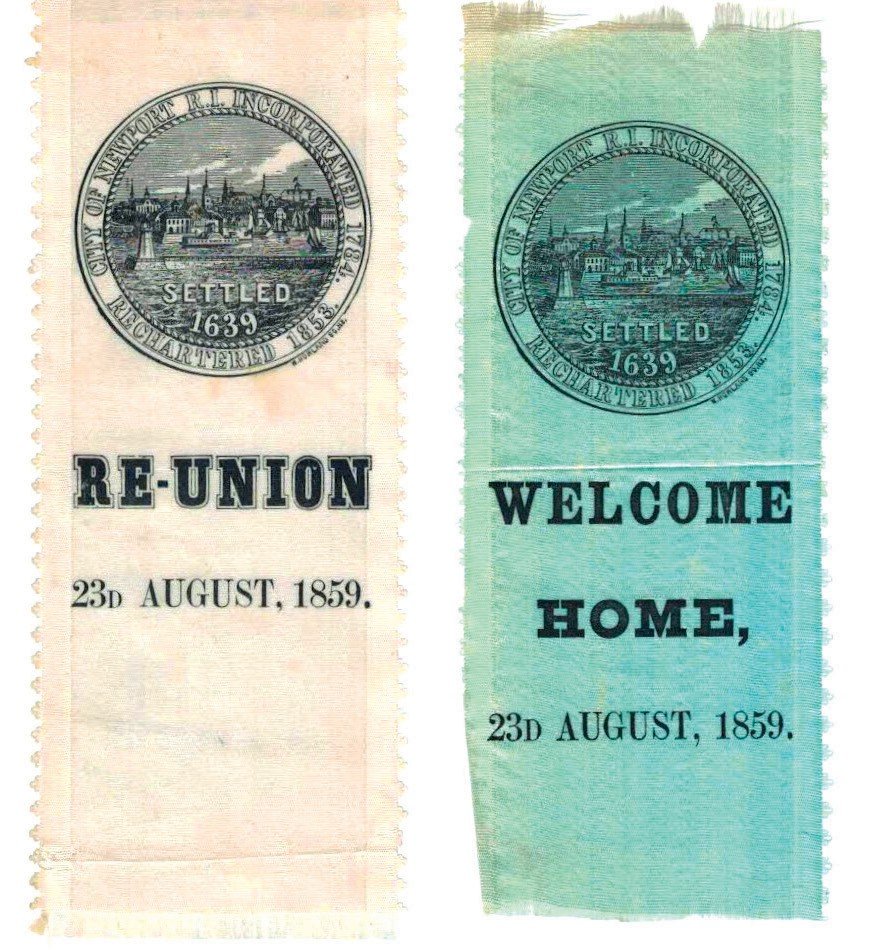
Old Home Days was a mid-19th century New England tradition in which former sons and daughters of a town returned for a reunion.
The first such celebration in Rhode Island occurred in Newport in 1859. Nearly 500 former Newporters living in the state attended, with around 300 more coming from Massachusetts, 132 from New York and one from as far away as England.
In all, around 1,200 people returned to their former home in Newport. It was said that so many people were looking to sign the registration book at the mayor’s office that the book had to be disassembled and the pages were spread out to speed up the process.
— Russell DeSimone
